Showing posts with label Crimean War. Show all posts

Tuesday, December 12, 2017

'Almost the Alma' Black Powder Game

I ran my Black Powder 'Almost the Alma' Crimean War scenario at Ambuscade!, an one-day historical wargaming event that I helped organize, which was very fun by the way, and anyone and everyone is encouraged to attend next December.  The scenario set-up was the same as the previous playtests, with the following changes to unit profiles and composition:

(1)   Previously all the British cavalry units were classed as "small", with their hand-to-hand and stamina stats reduced accordingly. For this game I graded them up to "normal" size, which gave the British heavy cavalry units (Heavy Dragoons and Scots Greys) eight melee dice and the light cavalry (Hussars) six.

(2)   Per the Crimean War scenario from the back of the Black Powder rulebook, I upgraded all the Russian infantry to have a stamina of 4 instead of 3.  This acts as a counterbalance to the general lack of special rules for the Russian side as well as the plethora of special rules for the British and higher British staff ratings. 

(3)   I also calculated the point values for both sides using the appendix in the Black Powder rulebook, and using all available figures, the Russians start the scenario with a 200+ point advantage (approx. 1,200 vs. 1,000).  I went ahead with this since I figured the British need the challenge since they have so many factors in the their favor, especially the higher staff ratings.

The rough outline of the game was as follows (I did not take many pictures – I was having too good of a time!):


(Above: the Cossacks advance on the Russian left (bottom of photo) while the British heavies tussle with the Russian lights on the opposite side of the board)

Both sides advanced.  The Russians sent cavalry probing attacks out on both flanks.  The Russian light cavalry, consisting of dragoons and hussars, were effectively smashed by the British heavies, and the Cossacks on the other flank were turned back, despite 2-to-1 odds, by the British Hussars.  The Russians established a very long, dense firing line of infantry in the center of the table and attempted to out-shoot the British.  Most of the British infantry responded by falling back a bit to be out of Russian range but still in range to counter-fire with their longer-range rifled-muskets. 
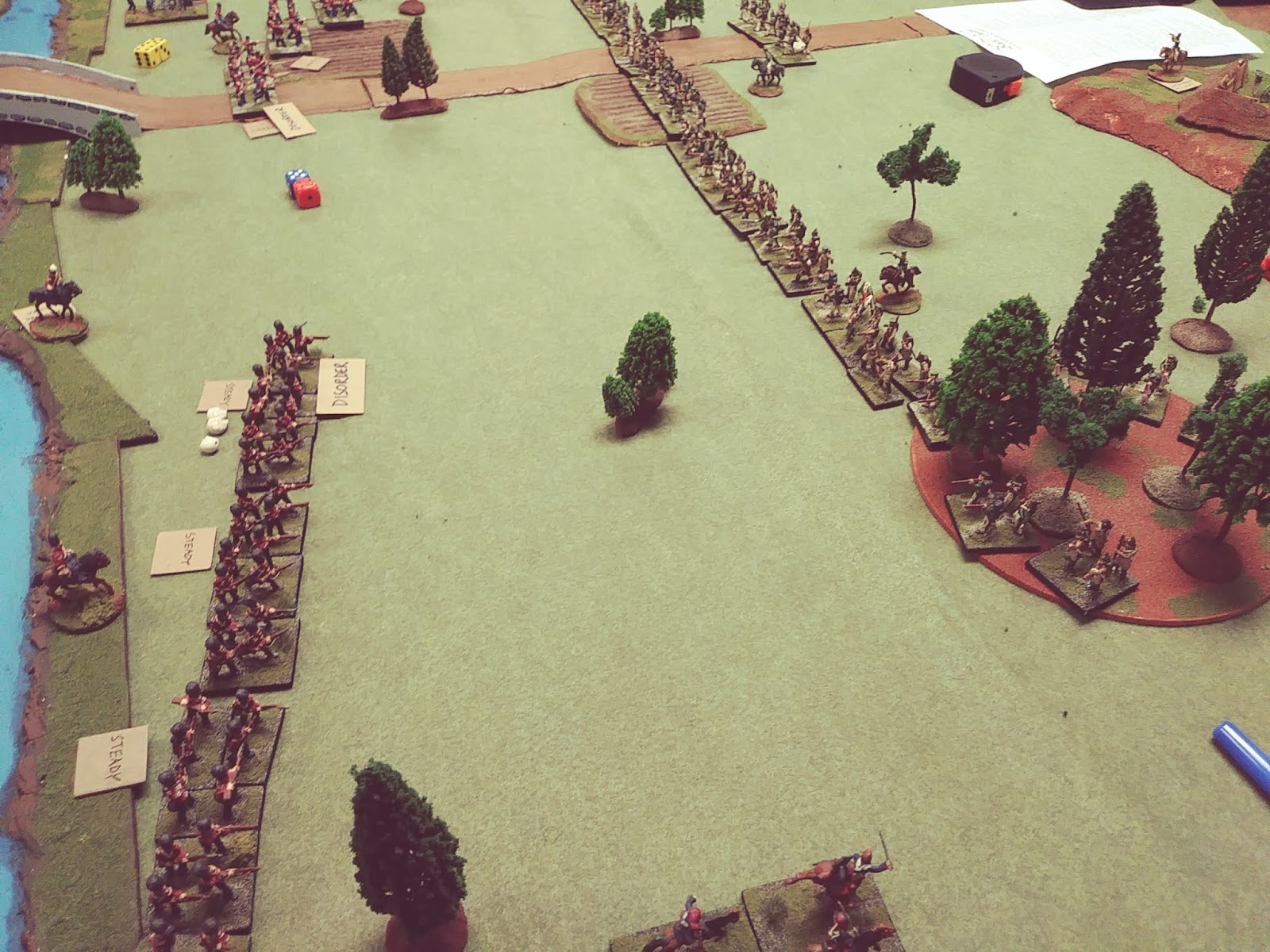


(Above: the long green line of Russian infantry straddles the board)

Meanwhile, a unit each of Heavy Dragoons and Scots Greys succeeded in getting all the way to the Russian edge of the board, and turning and charging one of the Russian redoubts, and taking the position – an automatic partial victory for the British! 

At this point the Russian players conceded the game, since there was no infantry in reserve to protect the other redoubt position, and losing both would be an automatic full British victory.

I think the scenario was fair in terms of troop dispositions, and a review of the rulebook the next day confirmed that I did not adjudicate any rules wrong (phew!).  I'm a little curious why the Russian players chose to stop their advance midway across the board and engage in a musketry duel, which hurt them because it whittled down their superior stamina score of 4.  With the British heavy cavalry scattered about on the Russian flank, its seems there was a missed opportunity for the Russian infantry to put some serious pressure on the British center.  Also, a few infantry units protecting the Russian guns would have been useful in retrospect.

As in the playtests, I ignored the 'brigade morale' rule (it is optional, after all) and just tracked army morale instead – so if over half of one side's units were lost (either off table, destroyed, or on table with 'shaken' status), the entire army was deemed broken and would commence retreat.  I really recommend this method, with a visual scorecard of some sort to track how close each side is to breaking, for Black Powder and probably Pike&Shotte and Hail Caesar! as well.

Sunday, November 26, 2017

'Almost the Alma' Playtest No. 2

With Ambuscade just a week away, I cajoled Gabe into coming over for another playtest of my Crimean War scenario, 'Almost the Alma', so I could continue to hone my knowledge of the rules and also see if the game was more competitive with the addition of three more infantry units and two more cavalry units per side.  The only other change was each side had an unattached Commander-in-Chief with a higher staff rating, which benefited both sides equally, it turned out.  We also remembered to use initiative moves which really picked up the pace in the second half the game. I also ignored the "broken brigade" rules and just went with overall army break point (when half of total units in army are shaken, destroyed, or off table, that army has broken), which eliminated additional accounting steps.

Long story short, the British infantry (me) on the British left failed to cross the river and set up in the woods for almost the entire game.  This gave the Russians (Gabe) the ability to set up a very lethal and sturdy fire line across most the board, which proceeded to pile concentrated fire on select British units with the help of their artillery on the heights.  The British heavy brigade (Scots Greys and Heavy Dragoons) charged and were rather easily repulsed, since aforementioned supporting infantry was not in the woods where they were supposed to be!  Still, with the help of the scoreboard to track total number of shaken units, it came down to a nailbiter in turn 7 where the British "Almaost" bagged a 10th shaken Russian unit but came up short. In the bottom of the 7th it took the final melee of that turn for the Russian to break some British Hussars and win the game.


(Above: end of turn 1)


(Above: end of turn 2, I think, with British having significant problems crossing the Alma)


(Above: around Turn 4 or 5, I believe, with British heavy brigade charging on British left and the Guards doing a nice job enfilading Cossacks on the left)


Overall, it was the most satisfying game using a Warlord Games ruleset I have ever played, and I really think it was the 'scoreboard' visual aid (my kids' old stand-up chalkboard, in this case) which made the difference - both sides knew exactly how close they were to collapse at all times and it helped focus both commanders with short-term game decision making and also added some narrative tension.

There will be a few more tweaks for the Ambuscade version of this game but otherwise I feel very comfortable and prepared.

Tuesday, November 7, 2017

'Almost the Alma' playtest

I'm running a Crimean War game at Ambuscade on December 2, and although I'm still furiously painting additional figures for that game, I figured we'd run a playtest with the armies that are currently table-ready.  Also I'm running Black Powder I have not played a ton so I needed the refresher. The scenario is basically the Battle of the Alma from the Crimean scenario in the back of the Black Powder rulebook.  The Russians command two earthworks, each atop a hill.  The British deploy on the opposite banks of the river across the board. Russians outnumber the British but the British have more special rules at their disposal.  The British objective is to take one earthwork for a partial victory or both for a stunning victory.  The Russian needs to break the British forces before they accomplish this.


The result was a pretty decisive Russian victory, which was troublesome for the upcoming Ambuscade game.  However, there were a couple muck-ups that probably made things easier for the Russians.  First off, the British player (me) complete forgot about the First Fire special rule which adds +1 to hit on any British infantry's first shooting attack.  Used correctly this could have softened up a spot in the Russian lines to break through later on.  Secondly, the British sort of walked calmly forward with little sense of urgency - the British player(s) need to really focus their forces on the earthworks and push hard from the get go.  Third, on a related note, the British heavy cavalry was barely involved at all, while Russian Cossacks succeeded in breaking an entire British infantry brigade (and basically setting up the eventual Russian win).

Some of these issues will also be corrected by the addition of more British troops, which should give them some resiliency and allow them to be a bit more aggressive early on.

Wednesday, June 14, 2017

Crimean War playtest

Over the last winter I painted British and Russian forces for the Crimean War using 1/72 plastics by Strelets.  Strelets is notable for (a) using a "chunky" 28mm-ish style of sculpts (which are fun to paint) and (b) offering many sets consisting of, say, "40 figures in 40 poses", which is ambitious and different, but does make "ranking up" war game units visually a tad more difficult than usual.  They do also offer some sets that are the more typical 10 poses with 4 figures in each pose.  I am planning to run a 5-player (2 British vs. 3 Russian) game using The Men Who Would Be Kings, but having not played that rule set since last December I wanted a refresher so a playtest resulted.

The scenario was adopted from the "Take the High Road" one provided in the rulebook. That scenario calls for a 18-point defending force vs. a 24-point attacker.  Since this a 2-3 ratio we set up two 23-point British commands vs. 3 Russian commands of between 21- and 23-points.  We also elected to use the optional rule of one leadership value for each command as opposed to one for each unit. The British rolled exceptionally well and ended up with two commanders with 5+ ratings (each unit would thus need to roll a 5 or better on 2d6 to move, fire, etc.).  We also chose to roll for "leader traits", which game the British nothing exception. The Russians were in trouble from the get go, however, as the commander of the Russian left (consisting of half the Russian infantry), rolled two ones on his trait and ended up being downgraded to a 10+ leadership (aka Major Hapless)!
Predictably, the Russian left immediately proceeded to fail 95% of its activation rolls and remained nearly stationary the entire game.  The Russian center advanced at a fair pace and the massed Cossacks on the right flew forward led by some Russian dragoons.
 
The Scots Greys on the British left countered by sallying forth and were beaten back with heavy losses.  However now at close range, the British were able to maximize their infantry firepower and the Cossack assault melted away. 

Since the Russian left was still in the starting blocks, the British right was able to concentrate all its attention on the advancing Russian center, and the newer, longer range British rifled muskets whittled away the advancing Russian infantry until only small remnants remained. 

The game's objective was for the Russians to occupy both earthworks by the end of 12 turns.  It was now the end of turn 5 and the Russian left was gone and the center in tatters, while the right remained firmly in command of Major Hapless with his 10+ command rating, so the game was called early.


Below: starting positions.


Below: Russian dragoons are out in front in the middle of the board.


Below: Russian center advances.


Below: Cossacks assault the British left.


Below: State of the attack by end of turn four - Cossack assault almost entirely wiped out, Russian infantry assault in center reduced to a few stragglers, Pin markers everywhere...


The Men Who Would Be Kings is of course supposed to be a colonial small battle rule set, and it does that very well, but the book does say it's for conflicts as early as the 1840s so the Crimean seemed like a decent fit. Both sides use standard Regular Infantry profiles, but with points reduced for earlier firearms and reducing Discipline from a +1 to a 0 (the Crimea seeming to mainly feature inexperienced, novice, or uncertain troops and commanders), so British infantry cost 4 points/unit and Russian 3.  Regular Cavalry only had a one point deduction for shorter ranged firearms (5 points).  Cossacks are unmodified Irregular Infantry (4 points).  The result felt appropriate based on the reading I have done on the Crimea, with nice-looking initial deployments become haphazard and lots of individual unit initiative, and the balance of the game hanging on utilization of superior numbers by the Russians versus optimization of better firearms by the British.