Showing posts with label Kings of War Historical. Show all posts

Saturday, May 18, 2024

Heawold (Kings of War)


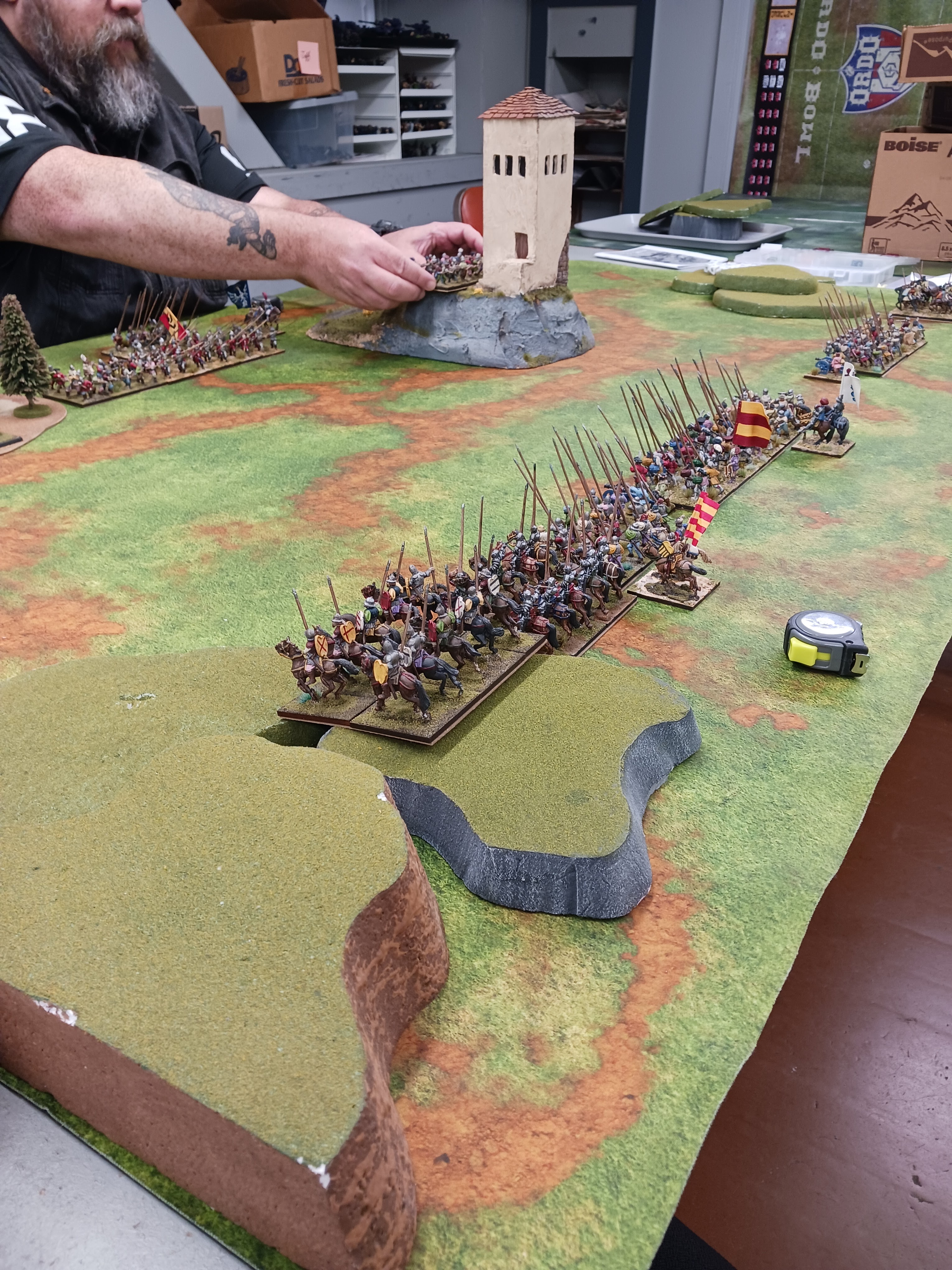
King Charles having struck a deal with the Scots for an army, a Covenanter army roams the north English countryside. At the farming village of Heawold, the Scots try to hit the Parliamentarian army from two sides.

This was a messy battle-game. Because the Scots placed infantry on thier extreme flanks and cavalry in the middle, the Parliament forces were able to entirely rout the Scot cavalry quickly, because it simply took a long time for the flanking infantry to get towards the middle again.

 The Scots infantry also took rather a lot of casualties closing in on the Parliament lines, and the whole thing looked a bit like a catastrophe for the Scots for a second. But then casualties on the Parliament army, with some selective last-ditch attacks by the Scots managed to force a tie.

Sunday, February 25, 2024

Enhill Wood

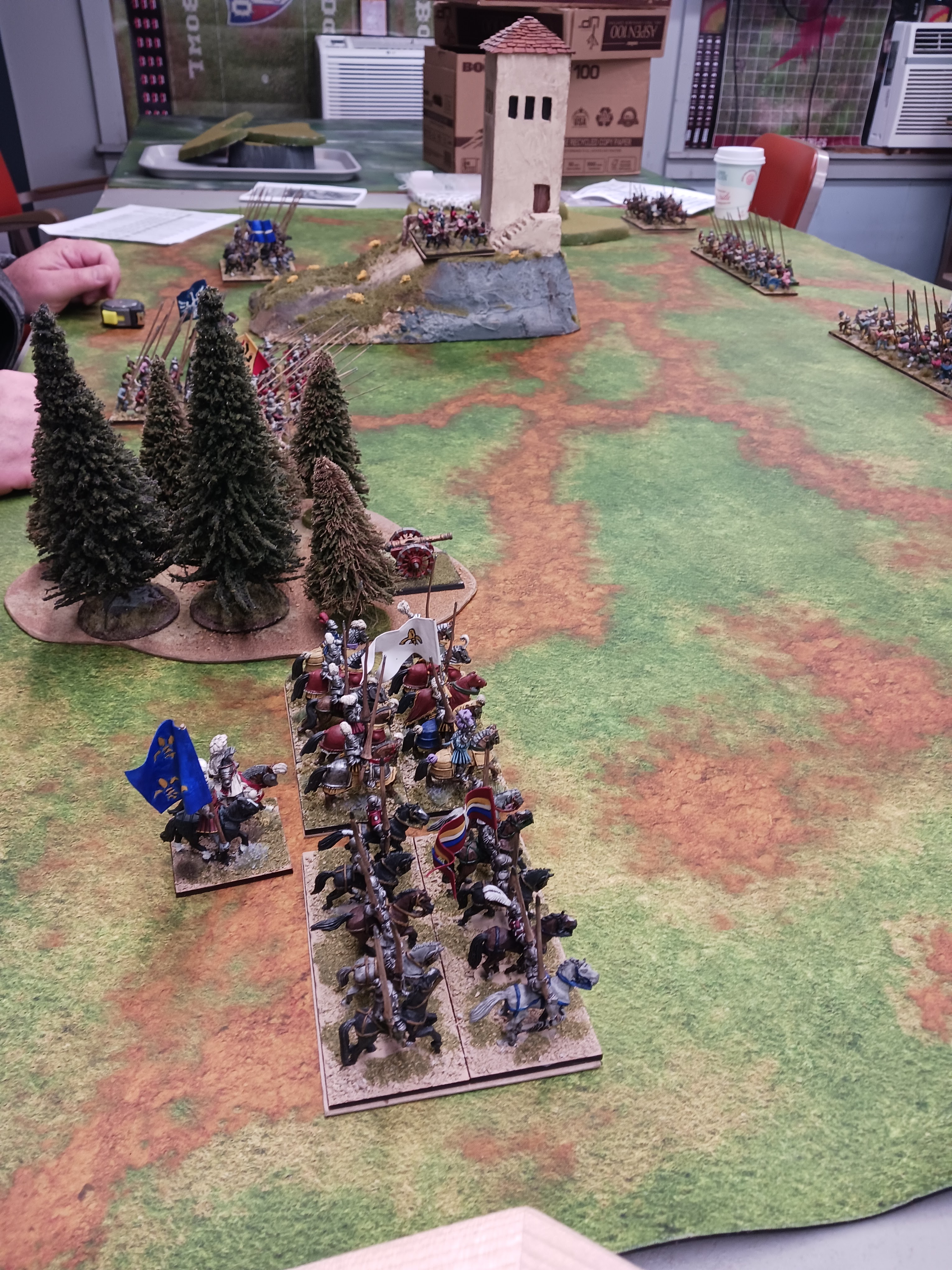
At Enhill Wood, Scots Covenanters, supported by local Parliament forces, met a Royalist force. The Scots cavalry was indecisive and closed too late with the engagement, giving the Royalists the victory for the day.


Monday, January 8, 2024

Clash at Cabluff

A Royalist army and a Parliamentarian army (with Scottish allies) met in arms at Cabluff, in the north of England.  The first game of the new year, using Kings of War Historical.  Unit profiles were taken straight from the 'Conquistadors' list, because that list has (a) Arquebusiers, which have the better effectiveness than handgunners, and (b) a cavalry-with-pistols profiles called Conquistadors. Accordingly, all pikes were Heavy Pikemen regiments, all cavalry were Conquistador regiments, and all shotte units were Arquebusiers.   Each side had the same number and types of units (3 pikes, 4 muskets, 4 cavalry) plus two cannon each and three mounted generals each. 


The scenario was the "Loot' scenario, whereby there are three obejctive tokens in along the center line of the table.  A unit ending its turn atop a token picks it up and carries it around. If that unit is destroyed in melee the victor can pick it up.  At the end of the game, the player with the most tokens wins.


Both sides deployed to try cavalry flanking strategies.  The Royalists deployed all of its cavalry on its right flank while the Parliament-Scots deployed two regiments on each flank. 


Both sides essentially succeeded in taking their respective right flanks, resulting in the complete route of the Royalist left and center.  But all the objective tokens were towards the Royalist right, so the it was to them that the victory ultimately went. 

The 'Conquistadors' list worked fine for English Civil War, allowing each of the pike-shotte-horse-artillery components to have their moment of great effectiveness. 


Would really like to add some dismounted cavalry to act as a sort of forlorn hope/sword-and-buckler type units to add a little more variety.  A great start to the new year of gaming!

Saturday, November 18, 2023

Action at San Astica

Was able to squeeze in a quick Italian Wars game using Kings of War Historical on Sunday last. French and Spanish/Imperial forces engaged at San Astica. Terrain established by randomized tiles. Standard Kings of War deployment (I go, you go, one unit at a time) Included a "horde" (double sized unit with higher 'Nerve' aka morale) of Swiss pikemen and of Landsknecht pikement for each side.  French only had one regiment of the elite chevaliers/gendarmes rather than the usual two.

First table appearance of my tower on a hill terrain piece!

The scenario was to get as many of your units to opposite half of table as possible by end of game.  The two hordes of pike ended up facing each other when deployment was over. Unfortunately, both sides were overly cagey and both hordes ended up barely moving and were routed from relentless missile fire. Whoops.


The French cavalry was again able to win the upper hand and things fell apart for the Imperial Spanish pretty quick after that.

A pleasant Sunday morning. What else can you ask for!?  Elsewhere, making good progress on painting another 20 stradiots.

Friday, October 6, 2023

Lance Fournies in the Fold

We played another Italian Wars game of Kings of War Historical.  Gabe played the French army, which consisted of two regiments of chevaliers, two men at arms, two cavalry, two Swiss pike, two crossbowmen, and two cannon. 

French on right, Italians on left.

I played an Italian army comprised of two regiments men at arms, two cavalry, three arquebusier regiments, three Landsknecht pike, one cannon, and two small cannons.  

French cavalry on French right flank.

For the scenario we placed an objective marker (a 1" cardboard chit) in the exact center of the board, and took turns placing one additional objective marker each somewhere on the centerline more than 12" from another marker and at least 3" away from any terrain pieces. At the end of the game (6 turns), if a friendly unit was within 3" of a marker, it scored that objective.  If an enemy unit was also within 3" of the marker, it was not scored for either side.

Initial deployments viewed from Italian right. Landsknechts started in the woods.

The two houses could be occupied.  They counted as height 2 (so they could shoot over other units), counted as cover (-1 to hit if shot at) and hindered charges (-1 to chargers to hit).  I just acquired the old 2019 Clash of Kings supplement, which includes siege rules, and incorporated its "Tower" rule to the houses - a shooting unit within the house could choose one facing each turn as its center point and measure line of sight from there. All of these rules worked well.

Starting positions - at the upper center you can see the "fold" between the two hills that the French nested their assorted cavalry within.  This kept them out of LOS from missile fire but in position to made a lateral charge or double move at the two objective markers.

Because objective points are not scored until the end of the game, this was the most both-sides-holding-troops-in-reserve game I have possibly ever played. This in turn made it a very interesting and enjoyable experience.

Landsknechts in Italian service tangle with Swiss in French pay.

At first both sides tried to hold back, with the exception of Italian arquebusiers and French crossbowmen moving up and into houses in the village at the center.  Italian Landsknechts took a direct hit from French cannon fire, and decided to advance on an objective on the Italian left. Hoping to lure the French out into the center of the field, the Romanian mercenaries on the Italian right on charged the French men at arms opposite them.  This Romanian unit managed to tie up the entire French left flank for almost three turns, as it scored a snake eyes on a nerve check (automatic pass) despite taking 21 casualties.

Romanian cavalry counterattacked from front and flank.

In the center, the Italians were able to disperse a regiment of Swiss pike with missile fire and a charge by the heavy cavalry. But by this point it was turn 5, so the French finally began committing their cavalry.
 
French starting to commit the cavalry, who had been sheltering in the fold between the two hills on the left.

In short order, the French were able to move within 3" of each of the objective markers. The troublesome Romanians, as well as some stradiots, were routed.

Landsknechts attacked from front and flank.

Romanians take 21 hits but pass nerve test anyway and stay on the table.

A thick melee on the Italian left.

The Italians had the last move on Turn 6, and although unable to route any of the French off the objectives, were able to also be within 3" of two of them, which causes those markers to not count towards either side's final score.

Landsknecht in waiting.

French have cleared the Italian cavalry from the French left flank entirely.

Situation before last turn.

Unfortunately, an oversight by the Italians caused a unit of landsknect arquebusiers to not move within 3" of the center objective marker - this allowed the French to score a solitary point and claim the field for the day!

Final combat on Italian left.

This really was an enjoyable game, with the addition of the objective markers really changing the entire look and feel of the game and both sides making very different choices than in previous games.
Friday, August 11, 2023

Too much organ gun

At some point, you end up with a collection that make two almost solid lines of figures across an eight foot table. This is same table as prior game, but Italians are now on left side and French are on right.

I did not take as many photos of Saturday's Italian Wars game of Kings of War Historical, which had a full four players and was played to a final sixth turn. But the game confirmed a growing suspicion by all involved... that organ guns in large numbers have an unbalancing effect, at least against the historical flavor of the period.

I should have brought different buildings that units could occupy - these ones just ended up being unpassable terrain created a weird gap in the center of the lines of which ever army was deploying on this side of table.

For deployment in these games, each side took a turn deploying either all their cavalry, all their pikes, or all their ranged units and artillery.  While deploying pikes early on, the Italians deployed all pikes towards the center and left the extreme right flank open. The French then two Swiss pike units opposite of that opening. The Italians, having already deployed all their pike, remedied this by placing two organ guns, a cannon, and a troop of Spanish arquebusiers in a tight line facing the Swiss, supported by some Balkan cavalry.

The concentrated firepower of the organ guns then proceeded to absolutely shred and rout one Swiss pike regiment and then the other. For those unfamiliar with Kings of War Historical, a cannon throws one dice to hit (on 5+) and then rolls a 1d6+1 for potential casualties.  An organ gun, however, throws 12 dice (also hitting on 5+).  The troop of Spanish arquebusiers added another 8 dice to the two organ guns, so the output in ranged attacks was overwhelming.

Swiss pikes facing their doom in form of Spanish organ guns.

"But isn't this exactly what happened at Cerignola in 1503?" you might ask. Yes and no? Because while gunpowder weapons were critical at Cerignola in repulsing French cavalry and Swiss pikemen, they were part of a more involved defensive deployment by Gonsalvo Córdoba.  This game, by contrast, had a few organ guns, without any additional support, out by themselves on a flank, which were able to entirely route multiple French units.  Rather than defense in depth, the French player commented that it felt more like attacking a machine gun nest via frontal assault. 

Swiss pikemen by Essex miniatures.

After the game (a devastating French defeat - the entire left side of the French army was routed), some discussion was had about what to do about the organ guns.  Perhaps modify their stats? I didn't like that as I want to avoid tacking house rules on to rules-as-written as much as possible. Better solutions pointed at simply not having too many organ guns, or creating deployment stipulations about where and how guns could be deployed (deployment stipulations might also work well for Spanish coronelías, or pike and cavalry blocks). 

French attacking the Spanish-Italian left flank (to some good effect).

I struck on a simpler solution a few days later at home.  Part of the issue is that I have two organ gun models and four 'Burgundian carriage' light artillery models, as well as six larger cannons. I have been treating the Burgundian carriage pieces as organ guns.  I usually give the French four of the larger cannons and two organ guns, with the Spanish/Italians ending up with an inverse of two cannons and four organ guns.  The Kings of War Historical book, however, includes a unit profile for a "small bolt thrower", which is actually stats-wise a down-scaled cannon (shorter range of 36" instead of 48", throw 2 dice instead of 1 but on success roll 1d3 instead of 1d6+1).  If all the Burgundian pieces use this stat line then there would only be a max of two organ guns available, and they could stipulated as "Spanish only" and be required to be deployed as in support of a coronelía.

Thursday, August 10, 2023

Lance Fournies debut


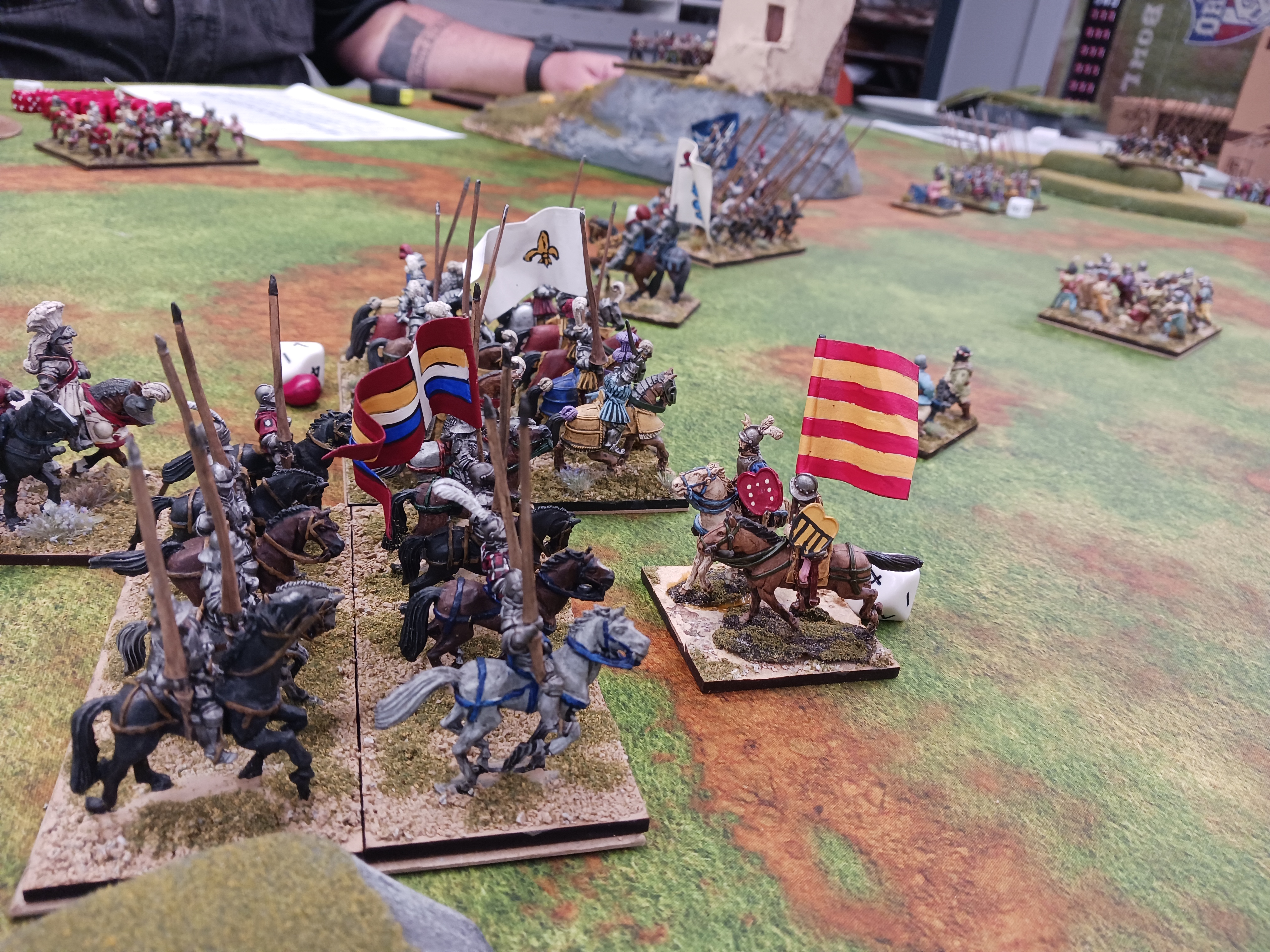
Last weekend was a special treat, as I got to play two games of Kings of War Historical in two days. The first game was on Friday evening. This featured the first tabletop appearance of my newly painted/reorganized French lance fournies (pictured above). 

Armies still being deployed. French to left, Italo-Imperials to right.

A lance fournie (French for "equipped lance") was a French cavalry organizational unit consisting of a gendarme (noble heavy armored horseman), a coutillier (a more lightly-armed fellow combatant), a non-combatant page, and three mounted archers meant as infantry support. The archers were intended to ride to battle and dismount to shoot with their bows, and did so until late in the fifteenth century, when they took to fighting on horseback as a sort of lighter variety of gendarme, though still called "Archers." For wargaming, a useful shorthand for this organization is a trio of units consisting of one gendarme (elite heavy cavalry), one coutillier (heavy cavalry), and one 'Archer' (regular cavalry).

Deployment done.
 
I already had three units of Gendarmes, and had six Old Glory 'archers' already painted as well, so I added 20 War of the Roses knights on unbarded horses as the
coutilliers, and got another 10 'archers' to add the the four unpainted ones I already had. Now the French can field 70 cavalry in a lance fournie set up (30 gendarmes, 20 coutilliers, 20 'archers'). 

Landsknects in Italian/Imperial service.

The game was at a leisurely pace and went smoothly. The French cavalry retained its punch with the new lance fournies organization but didn't feel unbalanced as much as before.

Balkan cavalry (stradiots and Romanians) in front of Elmeti heavy cavalry.

This game also featured the addition of several new banners to cavalry units.

Spanish infantry in my best impersonation of a 'colunella' formation - troops of arquebusiers interspersed between regiments of pike.

I also tried out a deployment scheme for the Spanish that mimicked the colunella formation.  This consisted of troops of arquebusiers alternated with regiments of heavy pike, supported by a few lighter artillery pieces ("treat as"organ guns). In the early rounds this formidable line was able to easily dispatch a French crossbow regiment with concentrated fire. However, the French generally kept their distance until the colunella began to advance, which created gaps in the formation which the French were able to exploit when they made their big attack in the center.

French coutilliers and 'archers' clash with Balkan light cavalry while heavier troops wait in second lines.

The decisive moments were around the third and fourth turns, when the French threw gendarmes and Swiss pikemen up the center of the table and were able to land flanking attacks (double attack dice) against several Imperial units.

The Spanish general directs the defense against a charge of French 'archers'.

Spanish infantry. In the distance another Spanish pike block is being flanked by coutilliers.

Landsknecht have taken the hill in the center. French heavy cavalry and Swiss pike starting to close in on French left.

Gendarmes flank a landsknect pike regiment.

French gunners look up to see Landsknecht above them!

French making a big push in the center, to good effect.

Things seemed dire for a second for the Imperials and their Italian allies, but they were able to counterattack with several flank attacks of their own, effectively routing and repelling the entire French attack in the center.


By end of game, French are doing okay on their right flank. But Swiss regiments are a bit far from the action still, despite engaging the Landsknechts on the hill.

Situation at end of game - Spanish have effectively routed the French left (crossbow unit at center right is all that remains) and are facing towards the center of the field. French attack in center reduced to an 'archer' and Swiss pike regiment each, both whom are vulnerable to flank attacks from advancing Spanish.

So another victory for the Imperials. I'm thinking that the Spanish colunella might need its pike components downgraded to 'regular' pike instead of 'heavy,' just to make the pikes and arquebusiers more dependent on each other.