Showing posts with label HAT Industrie. Show all posts

Saturday, January 21, 2023

Carthage vs Epirus - The Portable Ancient Wargame

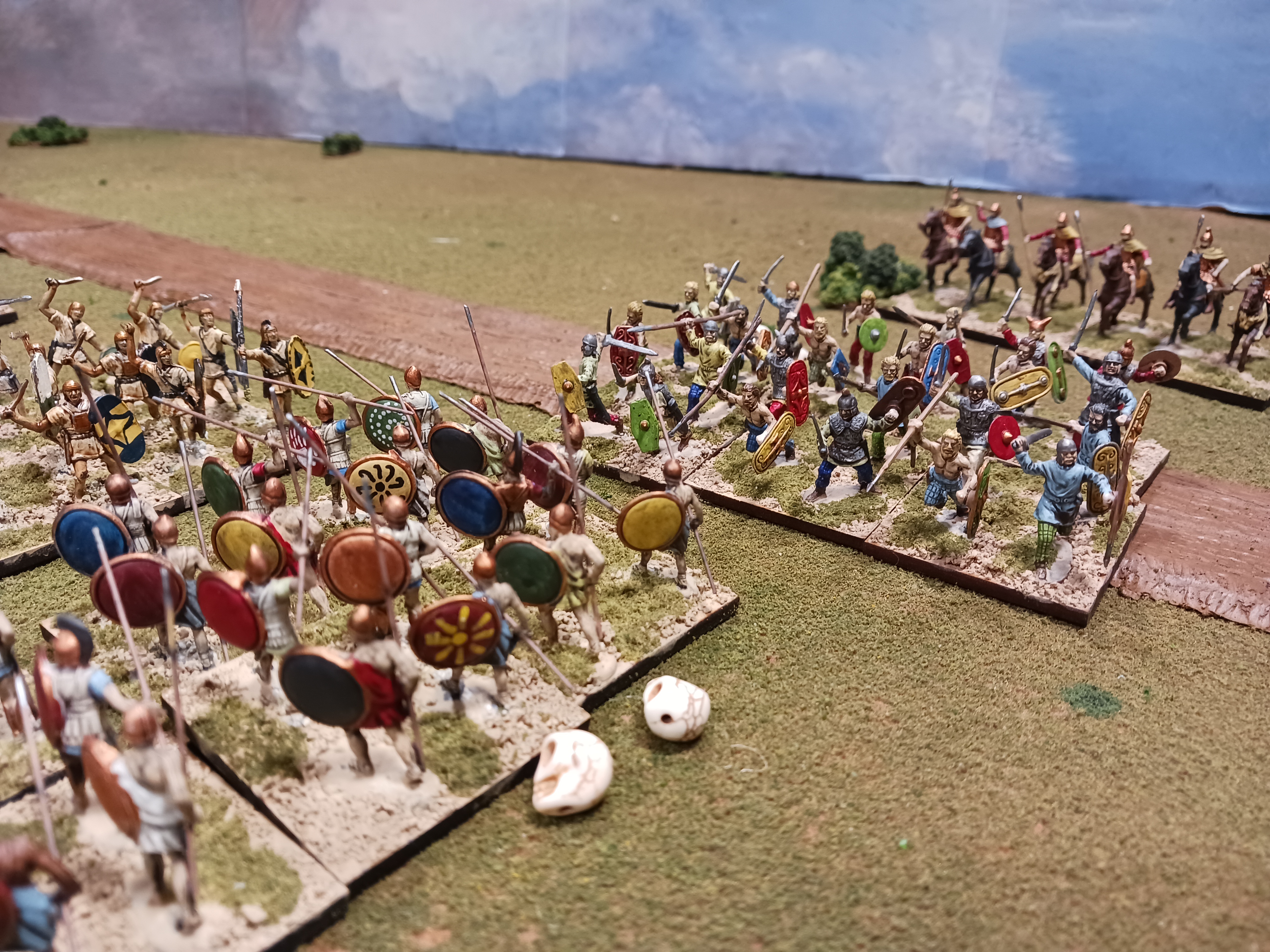
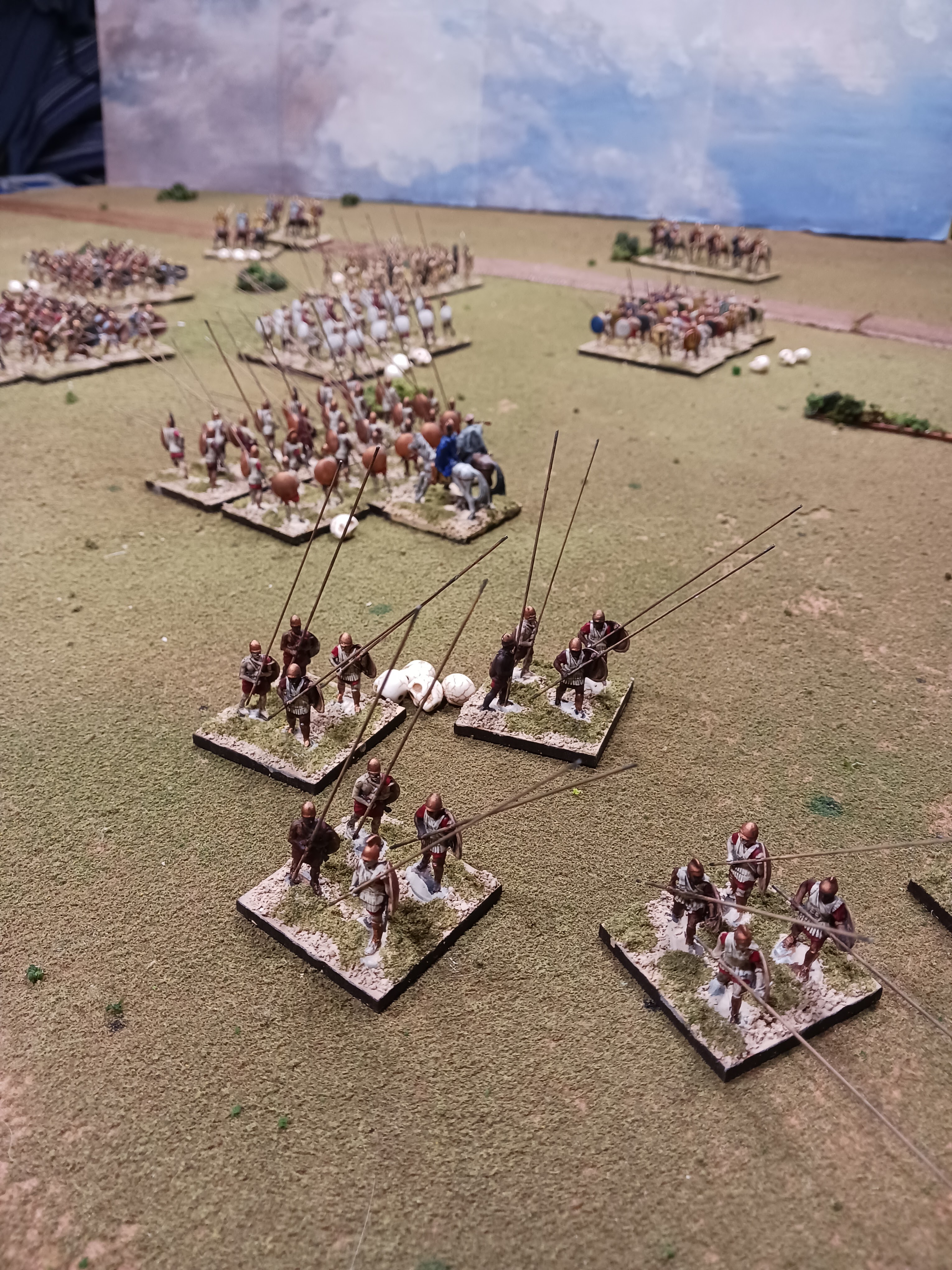
With the holidays over, I finally played this last of my round-robin ancient games, this time between Epirus and Carthage.  The rules again were the Ancient Portable Wargame, as published in Developing the Portable Wargame.  I used a rough draft, more-linear, randomized deployment chart and terrain tiles to complete the set-up.  The army compositions were again based off DBA 1e army lists.  This confrontation was of course fictional, as it features a later-period Carthaginian army facing off against the Epirotes, but how could I resist elephants versus elephants?

Epirote war elephants melee with Libyan heavy cavalry.

The randomized deployment landed all the heavy infantry in the centers, with the bulk of cavalry not across from each other.  The Epirote elephants were on the Epirote left, while Carthage's elephants were in the center.

After first moves, Epirus on left and Carthage on right. At the top, Epirote elephants rolled for extra move distance and went ahead and engaged Carthage cavalry.

In the Ancient Portable Wargame, elephants (along with light cavalry and light infantry) can test each turn for extra movement.  The Epirote elephants passed this test on their first turn, so went right at the Libyan heavy cavalry.

View from the Epirote left flank.

The Carthaginians, having four cavalry units to the Epirotes three, sent one of their Numidian light cavalry units galloping along the back of the Carthaginian infantry line to lend support to the Carthage left, where Epirote heavy cavalry had already routed the Baeleric slingers and was starting to flank the end of the Carthaginian battle line.

Balaeric slingers are routed, Epirote heavy cavalry is behind Carthage right flank.

Wanting to strike while Strength Points were still fresh, the Epirote heavy infantry commenced its attack on the Carthaginians, despite the Carthaginians being in better position with part of its line atop a hill.

Epirote heavy infantry engages the Carthaginian center.

While the Carthaginian elephants in the center held the hill, the infantry on the Carthaginian left gave some ground.  On the Carthaginian right, the Libyan heavy cavalry, assisted by Iberian heavy infantry, routed the Epirote elephants, giving the Carthaginians an advantage over the single remaining Greek light cavalry unit.

At lower right, the Epirote war elephants are routed by Iberian infantry.

Said Greek light cavalry unit eluded destruction, however, and the Carthaginian massed cavalry did not make easy headway in attempting to flank the Epirote left. Worse yet, the Carthaginian chance cards had burned off a rally card early one before even losing any Strength Points, so the Epirotes were attacking from a position of confidence that they could rally some losses.


Epirote light cavalry and a phalanx of heavy infantry are working to turn the right flank of the Carthaginian infantry.

The Epirote infantry continued to make headway against the center and the Celts and Iberians at the flank ends of the Carthaginian battle line were taking a beating, while the victorious Carthaginian cavalry on the Carthage right had to abandon efforts to turn the Epirote flank in order to deal with the persistent Epirote light cavalry.

Epirote light cavalry brings Iberians to brink of routing
Epirote hoplites trying to flank the Carthage line.
Things looking shaky for Carthage, with both flanks curving back...

BUT THEN, a good turn of luck on the chance cards! Epirus draws "Loss of Nerve" which confers a -2 on all melee rolls. Although Carthage draws a "Confusion" card (no movement), many of their units are already adjacent to Epirote units, so no movement is needed to engage in close combat.

 Carthage's attacks go well enough bring Epirus roughly equally close to its exhaustion point.

Celtic mercenaries attack Epirote hoplites in flank.

Epriote line thrown back, but the Celts route, at top.

Although the entire Epirote battle line is pushed back, the Celts do route, having already taken too many lost SPs.

Celts on Carthaginian left are routed.

Carthaginian war elephants.

Fortune then seems to swing back to Epirus, with the Iberians on the Carthaginian left routing...

Iberians on Carthaginian right are routed.

But then Epirus draws its second Loss of Nerve card! Heavy Epirote cavalry is routed on its right flank.

Epirote heavy cavalry are routed.

And the pesky Epirote light cavalry is routed on its right flank.

Epirote light cavalry are routed.

And the Carthage come-back victory is sealed when a phalangite block is routed in the center!

Epirote phlangites are routed.

Defeated Epirote commander.

Victorious Carthaginian elephants!

The chance cards really delivered the goods for this game, making what was starting to look like a bog-standard Carthaginian defeat (wherein they basically just get pummeled by a more heavy infantry-focused opponent) into a narrow victory.

Overall, this round robin sampling of battles lays some good foundations for potential solo campaigns. the DBA 1e army lists created competitive armies and gave each their own character.  More importantly, with the 12-units-per-army system in place, the simple campaign system at the back of the 1e rulebook can be used.
Tuesday, August 10, 2021

The Portable Ancient Wargame in 20mm


Having fallen for larger 24-figure heavy infantry units, I painted up an additional box of HAT Roman Hastati/Velites and a box of Princepes/Triarii, which let me field a Roman Republic army of 2 units each Hastati/Principes/Triarii, plus 2 Velites and 2 heavy cavalry. This a paper strength of 36 strength points the ancient rules in Developing the Portable Wargame.

Initial Carthage positions.

To face them Carthage brought 37 points consisting of 3 Libyan heavies, an Iberian heavy, Gallic heavy tribesmen, 1 Libryan heavy cavalry, 3 Numidian light horse, an Iberian light infantry unit and a unit of Balearic slingers.  The table was set using the blind tile draw from my Italian Wars battle generator and deployments determined using a randomizer I drafted for use in Late Roman games. 

Draft ancients deployment table.

Carthage rolled a "1" and Rome a "5".  I need to add a subset for deployment of elephants, although for this game I just counted them as the heavy infantry.  With the table set, Carthage was attacker so went first.

After second turn.

After one round of moves, both sides shifted sideways so as to be across from each other in the open, flat ground.  Carthage sent the 3 units of Numidian light horse forward to harass the outnumbered Roman cavalry on the opposite flank.  The Romans moves velites, hastati, and a cavalry unit forward on its right in a demonstration to scare off any Carthagenian flank moves.

Roman heavy infantry line.

Carthagenian heavy infantry line.

With just one Numidian horse doing quite well at keeping the Roman left cavalry at bay, the other two Numidian units scurried across the field and made javelin attacks against principes and triarii by the woods. Unlike some previous games, I read (and remembered!) the rule that a light infantry, light cavalry, or elephant unit may make a double move if testing and passing on a 5+. Light cavalry and especially the light infantry became much more dynamic as a result. 

Both sides positioning their lines, while Numidian horse harasses the Roman right.

Numidian horse engaging Roman cavalry on Roman left.

Numidian horse skirmishing with Roman infantry on Roman right.

With the opposing lines of infantry now fully lined up with each other, the Numidian horse passed through their friend lines and guarded against a possibly flank attack by Roman cavalry. The Roman heavy infantry line had the option of being the first to charge into close combat, but opted to move one square forward and throw pila instead (pushing back one Libyan heavy infantry and dropping a SP on another).

Pre-contact. Roman pila have driven some Carthagenian infantry back.  Numidian horse has moved to extreme Carthagenian left to fend off potential flanking move by Roman cavalry and velites.

Roman infantry arrayed with hastati on flanks, principes in middle, and triarii in reserve.

Carthage elected to throw the punch, however.  They caused some lost SPs and took some lost SPs, but overall the lines remained "locked in."  The critical action was that the Iberians on the Carthagenian right were able to sweep Roman velites aside and flanked the adjacent hastati.

And the clash - the Iberian infantry in the foreground dispatched the velites securing this flank and were then able to turn and flank the Roman hastati, who were also attack to their front by Libyan heavy infantry...

This hastati unit promptly fell from 3 SP remaining to 1 SP...

Hastati with three of four SPs lost...

...and then to zero. Coupled with a lost cavalry unit and lost velites, along with lost SP up and down teh line, the Romans had lost 12 of 36 points so were over their exhaustion point (with Carthage still at 9 or 10 lost).  This meant that Rome could not move towards enemy units anymore, although it could shoot at units in range and could engage in close combat with enemy still adjacent. The game would end when one side or the other lost a full 50% of starting SPs (taken from The Portable Pike & Shot Wargame).

Hastati destroyed. This pushed Romans past exhaustion point.

The Romans succeeded in destroying the Gallic infantry and pushing back the elephants, and pushing Carthage past its exhaustion point, but in the process the Romans also slipped past the 50% mark and victory went to Carthage.

End game. The Gallic heavy infantry on the Carthagenian left has been routed.

The defeated Roman general.

The victorious Carthagenian general.

When I first purchased Developing the Portable Wargame, it was so I could use the ancients rules for my Italian War collection and my Late Roman collections.  I had increased the size of my 20mm plastics ancients armies pre-pandemic, resulting a few Hail Caesar games, but between the somewhat absurdly long-to-play battle of Dertosa game, and the swingy combat results in the Scarponna game, I was considerbly less impressed with  Hail Caesar and wanting to try DtPW instead.  Like many of the previous Portable Wargame outings, I am again impressed with how a defeat seems to be related to a wrong decision rather than "a lot of 1s."  In this case, the Romans had an opportunity to have their heavy infantry attack en masse first, but did not pay attention to how close they really were to their exhaustion point, and opted for a round of throwing pila instead (to little effect).  This allowed the Carthagenians to make the en masse attack first, resulting in the turning of the Roman left flank and a victory for Carthage. 

These 20mm games are somewhat emotive for me.  When I became interested in wargaming again 10 years ago, I was initially drawn in by 54mm gaming (today manifest in my shiny Britains toy soldier games), but I also acquired the first four or six boxes of HAT 1/72 figures used in this very game (at a measely $5/box - they now cost $8-$9).  The eagle-eyed reader may notice that some figures are painted using a different technique and have a lot of chipping on spears and such (the chipping is because many of these little guys were relegated to being stored loosely in a cardboard shoebox for several years!).  So to have doubled the size of these armies, usually by painting more of the same sets I previously painted 10 years ago (to an arguably better standard!), its like an old friend from out of town coming to visit again.

The larger 24-figure units and resulting long lines of dense blocks are a big improvement visually, of course, and I look forward to some sort of campaign series, to be set either in Spain or Sicily.

Tuesday, July 27, 2021

20mm Ancients

Looking to play some Punic Wars, Sicilian Wars, or Pyrrhic Wars (let's just call it the 'Hellenistic Age') in the near future with my 20mm collection using the gridded ancients rules in Developing the Portable Wargame.  Assessing the existing armies, I noticed that a 24-figure unit (six 40mm square bases) looks way sexier than 12-figure, and also fills up a 6" grid square better.  Switching to this would give me a lot of armies with four heavy infantry units, supported by three or four 9-figure light infantry units (3 figures to a 40mm square base) and at least two cavalry units (I could go with 6- or 12- figure units on this, both look fine).  While a 9 to 10 unit game will work just fine in Developing the Portable Wargame, some of the armies still felt a little on the small side if switching to 24-figure units. So painting has gotten underway and more figures acquired.

Here's what I've managed to finish up this last month, despite a busy summer calendar:

96 Macedon (or Pyrrhic or Successor state) phalangites by HAT.  The pikes are steel wire. They were attached to figures by heating one end (of the wire) over a candle and attaching to the figure while still hot - the soft plastic melts and sticks and the wire embeds a bit.

Some of these are clearly facing to the right, if you look. Its peculiar these were sculpted this way when the overall set is clearly meant to be arranged in a multi-ranked block of sarissas. Oh well.
Thessalian cavalry by HAT.

I'm not a big fan of the figure at back right corner, with his arms out akimbo. I should have used hot water/cold water treatment to reposition his arms. Oh well.

Celt infantry by Caesar miniatures. I paint 16 of these for Hail Caesar over a year ago (two years?). I painted up 8 more and finally based them to get this unit of 24. This unit will really help bolster Carthagenian infantry lines.

Like most sets that feature forward-rushing ancient infantry, positioning the figures on a multi-base can be a bit of a pain. Especially when you have some figures who are clearly not rushing forward. You do the best you can and probably no one else even notices...

Tuesday, August 4, 2020

Great Helm Grenadiers

I saw a passing reference a few weeks ago to #Turnip28* and didn't really think much of it.  I guess it fermented unbeknownst to me and then bubbled up again last week.  I have a lot of 54mm Napoleonic infantry, painted in "imagi-nation" uniforms that have lived unused in boxes for several years now (their last outing was a game of Charge! in 2015).  I also had some unpainted Timpo knights that have really funky helmets.  I had some unpainted Wuttemberger grenadiers, and with about an hour of tinkering these first three fellows of the Great Helm Grenadiers were born!


The tattered cloaks are torn paper towel bits, coated in diluted PVA (wood glue).  


The turnip28 minimal backstory is that the Napoleonic Wars never ended, and that some sort of invasive turnip showed up that killed other food sources, and that eating said turnip causes you to grow these turnip/tumors.  At 28mm this is easily represented with some static grass, but I'm not sure how to pull this off on 54mm figures.  Still pondering that part.  Anyway, you have these warband armies that scavenge medieval armor and are muddy and don't actually fight for the original Napoleonic powers anymore.  


All of this is a great excuse to mess around with custom figure creation and also paint Napoleonic infantry free from the dread uniform accuracy bug.  For these three, I ended up doing the jackets in a blue with yellow cuffs like the original Wuttemberger grenadiers, but I did pants in brown or grey rather than white. I tried mud splatters for the first time, using a sponge brush. This is a bit unnerving since you're blotching brown paint on a "clean" painted figure!  But the mud can help tone down the blue and yellow.  Finally the whole think was given a black wash.


I'm going to do another 9 of these Grenadiers (I have the Timpo heads for them).  I also ordered 100 Marx knights for $20 to serve as more donor heads to the other 54mm plastic Napoleonic figures.

* Here is some turnip28 info, sparse as it may be:
A Blog post (described it as "dark fantasy Napoleonic wargaming with a horrible root vegetable theme")
Another blog post