Showing posts with label Pike & Shotte (Warlord Games). Show all posts

Tuesday, June 20, 2023

Somewhere in Verona - Pike & Shotte Porch Game

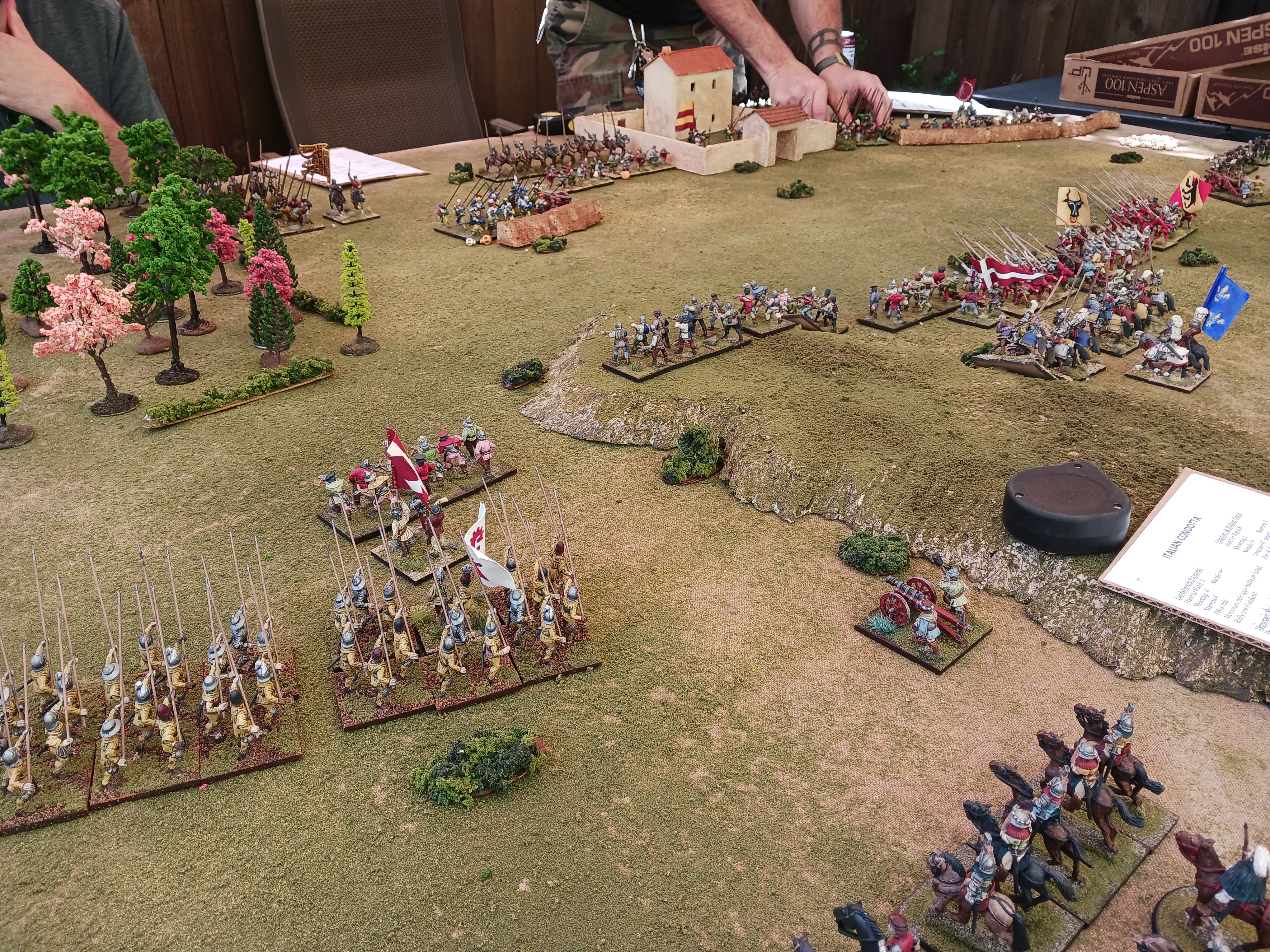
I finally got around to trying out an Italian Wars game using Warlord's Pike & Shotte ruleset, while also hosting my first porch game of the season.  I perhaps cruelly used my guests as lab rats and mostly ran the same experiment as an earlier Kings of War Historical game: the question being, could an Venetian/Italian alliance army consisting mainly of arquebusiers, light horse, and a few Landsknecht, as well as the benefit of some earthwork defenses, stand a chance against a French army comprised of heavy horse and Swiss pike with some crossbowmen? 

The answer, at least with Warlord's Pike & Shotte rules, using the Italian Wars lists therein, appears to be rather definitively no. I can't really tell if the problem is that the Italian Wars lists are poor, if a few select rules simply played to much to the advantage of the French, or if Pike & Shotte is better suited for the English Civil War and Thirty Years War, and the Italian Wars (at least the part of them I am interested in - 1495-1515 or so) are simply "too medieval" which makes Pike & Shotte a poor fit.

One glaring issue was that the French crossbowmen had a range of 18" versus the Italian arquebusiers' 12".  This severely neutralized the Italians' edge in number of missile units.  Another issue is that French mounted crossbowmen have more melee dice than the Italian stadriots, again neutralizing a possible advantage.  Lastly the Warlord penchant for loading some units up with lots of bonues and special rules mostly worked for the French advantage (the Gendarmes and Swiss pikes).

The Italian players were good sports and played cagey.  The French assault on the earthworks on the Italian left went far better than it should have, and the lay of the land (generated randomly with terrain tiles) allowed French mounted crossbowmen to completely bottle up the Italian extreme right flank.

The Swiss and Gendarmes performed well, and half the Landsknechts never even really engaged.  A French victory, rather predictably, mostly.

When I first started collecting Italian Wars figures, my intention was to use these rules.  But then Pikeman's Lament came out and Stuart at Army Royal gave me his Italian Wars Lion Rampant variant. As I was focused on running convention-style participation games, I leaned heavily into my own Lion Rampant variations for several years.  The pandemic forced a "cold turkey" stop to this.

Since then, I've tried out the super simple Portable Wargame and aforementioned Kings of War Historical, which is also very streamlined. Both are also very fun.

After the game I got some  excellent feedback from the players. High on the list was the importance the longer range of the crossbows played in both sides strategies. No one agreed that this felt accurate.

I voiced my interest in trying Kings of War Historical out in a multiplayer setting. I got some push back on this, in terms of ruleset-hopping, which is a legit complaint - I would couner that Pike & Shotte is still my go-to rules for the English Civil War, where the same-same nature of the opposing armies negates the problems seen in this game.

Of course, it was great to finally get so much of the Italian Wars collection out on a table, and the weather was very agreeable.


Thursday, August 4, 2022

Somewhere in Yorkshire - Pike & Shotte Porch Game

In spite of a forecast of a 99-degree high, I set up my new, wider, sunshade umbrella and  played another game of Pike & Shotte on my porch with my longtime opponent Gabe.  

Royalist foot.

I again used the force randomizer from my earlier Portable Pike & Shot Wargame battle maker, this time creating a war-in-the-north scenario (thus placing it somewhere in Yorkshire, probably in the west riding).  I have also acquired the To Kill A King supplement by Warlord Games, so pulled suggestions or elements from that into the set-up as well.  The randomizer gave the Royalists two battalias of Whitecoat foot and one regular (recall that per prior game, I am usig combined units of pike and shot with the 'pike company' rule).  Per To Kill A King I split both the Whitecoat battalias into 'small' units for a total of four units of Whitecoats instead of two. Parliament ended up with three units of regular foot, and both sides had 1 commanded shot, a medium gun, a light gun, and five cavalry. The roundheads were commanded by Thomas Fairfax himself using stats from To Kill A King.  Because Parliament was outnumbered, they received 12" inches of earthworks (based on a points calculation to make both sides even) which could placed along the halfway mark of the table, with artillery deployed therein with some infantry in support.


I then dealed out six terrain tiles as shown above, and placed terrain accordingly, as seen below.


I then diced for deployment using my battle maker.  Gabe placed his earthwork atop the hill near the center of the field, directly in front of the mass of royalist Whitecoat foot, and put his falconet light gun and one foot unit in to defend it. 

Initial set-up on Royalist left. The four small units of Whitecoat foot are at bottom, directly across from some Parliament foot in the earthwork.

This game used the same 'Exhausted Army' rules as the prior game.  So if at the beginning of a turn, an army had "lost" 1/3 or more of its units ("lost" being defined as having left the table, or being shaken), then it was "exhausted" and basically teeters on the edge of breaking entirely.  Both armies can be "exhausted."  When half or more of one army's units become "lost," that army breaks, has lost the battle, and the game is over.  The most notable detriment to an exhausted army is that the morale rating (i.e. saving throw) for all units is reduced to a 6 only - this obviously makes the ability of the opponent to push the exhausted army to half or more units as lost much easier. Because the Royalists had 11 units (not counting artillery), their exhaustion point was four units.  Fairfax had only 9 units, so his exhaustion point was three units lost.

Initial set-up looking at Royalist right. The three units of Parliament cavalry are deployed in front of the foot.  The opposing command of three Royalist cavalry are deployed behind the woods.

The flow of gameplay was as follows:  Fairfax advanced his cavalry on the Parliament left.  The Royalists attempted to position their opposing cavalry on the Royalist right to set up a charge.  Instead, they blundered and charged instead. 

Initial setup viewed from Parliament left. From this view you can see the cavalry battalias on the opposite end of the table (two units vs two units). You can also better see the Royalist advantage in number of foot units.

The Parliament cavalry offered closing fire and cost the Royalists a casualty.  The Royalists lost the subsequent melee and fell back.  The Royalists advanced the Whitecoat infantry closer to the earthwork so as to all be able to fire muskets upon the earthwork.  The combined 8 shooting dice did manage to cost the Parliament defenders one stamina. 

A fresh Parliament foot unit moves up to cover the flank of the earthwork.

Earthwork defenders.

Back on the Parliament left, the Parliamentarian cavalry charged in again, and won the melee.  The Royalists rolled snake eyes on their break test (!) and fled the field.  The supporting unit of Royalist cavalry rolled a 3 on its break test and also fled.  On the other side of the field, the Royalist cavalry on the Royalist right attacked its opposing Parliament cavalry, won the melee and pushed them back, and then made a mandatory follow-up due to their galloper rule (Northern horse was rash, being decedents of old Border Reiver families).  On the follow up they lost the melee and... rolled a 4 or less on their break test and fled the field.   

Getting close to end-game. Parliament is massing its infantry in the center.  The Whitecoat attack on the earthwork can be see to the left. 

The Parliament cavalry then charged what was left of the Royalist cavalry, and although one Parliament squadron was broken, the Royalist left now had no cavalry remaining, and but one squadron remaining on the right.  While all of this was going on, one company of Whitecoat infantry had become shaken from musketry and artillery fire from the earthwork.  This equated four "lost" units, so the Royalist army was now close to breaking entirely (which makes sense seeing as the foot in the center had watched the cavalry on the left break and run almost immediately and seen the cavalry on the right push back the Parliamentarians at first, only to be completely destroyed).


However, two the Whitecoats companies of foot (the other two were both 'shaken' now) were able to mount a melee assault on the earthwork.  After one round it was a draw so they remained 'locked in.'  The remaining, non-Whitecoat, Royalist infantry company advanced in the center, and although it took heavy musketry fire, kept rolling 6s on its saves, keeping it (and the entire army) in the game.


The Royalists were able to cause a second Parliament unit to become 'lost,' and for a second it seemed like they might be able to cause Fairfax's army to also become exhausted. 


However, on the second round of melee, the Whitecoat attack on the earthwork fell back. 


And then the remainder of the Parliament foot in the center combined to attack the red-jacket Royalist foot, and given the 6 saving throw, were able to break that unit and win the game.

The decisive attack in the center by the Parliament foot.

This was a really quite enjoyable game. The exhaustion/break point rules worked well (again) in creating a tense end game situation.  The larger Royalist army was counter balanced nicely by the earthwork given to Parliament.  It is also probably worth mentioning that having a stand-alone army general (i.e., not attached to his own battalia) who can issue orders to battalia units who already failed an order issued by its battalia commander is of immense value in making the game move along.

Playing outside is also nice, despite the heat. I look forward to more outdoor games, but late summer plans might conspire to prevent any more games until September.  
Thursday, July 14, 2022

Somewhere in Cornwall - Pike & Shotte Porch Game

Two weeks ago I purchased two eight-foot folding tables. When unfolded and set next to each other they make a eight by five gaming table. Last weekend I set this up on my porch and hosted the first multi-player game at home in two and a half years.  We played an English Civil War game using Warlord Games' Pike & Shotte rules, which I have not used/played since 2017.

Parliament starting positions.

For force determination I used a slightly weighted variant of the force randomizer from my Portable Pike & Shotte Wargame campaign system (weighted in that it was trying to get as many units on table as possible so that all four players had a nice mass of troops), with deployment and terrain also determined with that toolkit.
 
Cornish foot on the Royalist side.

That same force randomizer was used to create unit variety between the two armies.  I used the Hopton-and-Waller in Cornwall-and-the-South early war lists, and Parliament ended up with two units of Curaissier cavalry (i.e. Haselrig's Lobsters, who turned out to be quite effective with their 3+ morale), offset by half their infantry being "freshly raised" Train'd Bands.  Half the Royalist infantry was Cornish Foot (with 'Stubborn' rule) but they had no Train'd Band infantry and they had an extra unit of commanded shotte.  Parliament also had three guns (two medium, one light) to the Royalists' two (one medium, one light). 

Starting positions, Royalists on the left, Parliament on the right.

I also modified the "broken battalia" rule from Pike & Shotte to mirror the Exhaustion Point/Break Point rule from The Portable Pike & Shotte Wargame.  Instead of individual battalias (each side had four) reaching break points, the entire army was deemed to be "exhausted" when one third or more of its units were "lost" (as defined under 'broken battalia' rule).  The negative consequences of this were then applied to entire army (most notably, all units morale became 6+) until one side lost 50% of more of its starting units, at which point it broke entirely and the game was over.

Royalist guns lining up shots.

So this 'Exhausted Army' rule was the first experiment being tried out.  The other was using infantry blocks that had pike and shot models in a single unit and using the 'pike company' rule and disregarding 'hedgehog' entirely.  This was also based on my positive experience with the 'battalia' units in Portable Pike & Shotte Wargame, which I felt gave a more realistic result than multiple units of 'musketeers' running around by themselves.

Royalist Cornish Foot (white jackets) have taken up position behind the hill in the center.

And the result did feel more realistic, I think.  The ebb and flow of the game (at least as I saw it) was that Haselrig's Lobsters threw back the Royalist cavalry on the Royalist right.  Meanwhile the Royalist infantry on the opposite flank threw back an attack by the Parliament cavalry.   

Royalist left taking a commanding position atop the long ridge. 

The Cornish foot attempted to crest the hill in the center, but the Parliament Train'd Bands held their ground, and the Cornish Foot was then flanked by some of Haselrig's Lobsters. On the Royalist left, the foot advanced in good order, delivering several volleys of musketry.  Both sides became exhausted at the end of a Parliament turn.

This is after the game ended. One of the two Cornish Foot companies has been broken, but the solid line of infantry on Royalist right has delivered the game winning round of shooting. 

The situation was that either the Royalists would win the game on their turn (by using shooting to push two or more Parliament units into 'lost' status) or would not and then Parliament would almost certainly win instead. The Royalists then did in fact cause three more Parliament units to become shaken and therefore 'lost,' and the Parliament army broke and the game was over.

Royalist commanded shot.

Overall, an enjoyable game played in a slightly-too-hot sun. Everyone arrived at about 11:00 and we were completely done a little after 2:00.  This included quite a bit of rules-looking-up as we figured out various minutiae. 

Parliament infantry. I think I need to rebase my command stands to 40mm square bases so they can integrate with my infantry better.

The combined pike/shot infantry blocks, the randomized deployment/terrain/armies, and the 'army exhaustion' rule all also worked very well (good to know that positives in one ruleset can be ported to another).  Also, the two eight-foot folding tables made an ideally sized game board. I shall have to make a custom 8x5 flocked mat for it to realize its full potential. 

I also think I would like to generally "touch up" the bases of almost this entire collection. The majority use my earlier basing method of beach sand with some flock applied (with sand painted dark brown or not).

A big mass of Parliament Trained Band foot. By contrast, some of the musketeers in the center of the photo use my more recent basing method - kitty litter then painted a "dried dirt light brown" with flock and tufts applied.  This lighter/brighter basing color scheme causes the minis to "visually pop" off the base better, I think. 

These blue-jackets are Warlord Games plastics.  Over half the pikes have snapped and been replaced with steel wire at this point. 

The two units of Haselrig's Lobsters can be seen in the center here.

It wasn't a factor in the game, but the Royalist cavalry on the Royalist right flank did rally and eventually start to move to reenter the fray. You can see them on right edge of the photo by the edge of the woods.

Here is the full text of the 'Exhaustion Point' ending-the-game rule, which is a modified version of the 'broken battalias' rule.

EXHAUSTION POINT:

If at the start of any side's turn, more than one-third of the total infantry or cavalry units in an army are lost then the whole army is deemed to be 'exhausted'. All the remaining units in the army are then obliged to follow the rules for exhausted armies as described shortly. Once an army is exhausted it remains exhausted for the rest of the game - it cannot recover.

A unit is considered 'lost' for the purposes of calculating army morale if:

It has been removed from the battlefield because it has been destroyed, or
It has left the battlefield either deliberately or otherwise, or
It is 'shaken' at the start of the turn (ie, if it has suffered casualties equal to its stamina)

Ignore artillery pieces when working out whether an army is exhausted, although artillery pieces will be affected by the rules for exhausted armies along with the other units. The exception to this is where artillery forms the majority of units in a battalia, such as a 'grande battery', where guns are counted along with any infantry or cavalry.
When an army loses more than half its units, it has broken and the game is over.

UNITS IN EXHAUSTED ARMIES:

The following rules apply to units from exhausted armies:

Units that have already left the table, or which leave the table from that point on, cannot return and arc deemed to be out of the battle for good. 
Units that are shaken cannot be rallied even if they are allowed to recover by means of some special rule. Once shaken, units remain shaken. 
Units that are disordered remain disordered from turn to turn. Units that have a 'save' against disorder or a special rule that normally allows them to recover can do so. 
Shaken units are allowed to make a single 'retire' move in the command phase instead of using their initiative or receiving an order. They can do this even if disordered - in which case it is the only move they are allowed to make. Retiring units must attempt to withdraw from the fighting in the most practical way possible. Artillery crew that retire in such circumstances are deemed to abandon their guns. 
Shaken units within 12" of the enemy and not already engaged in combat must retire as described above unless occupying buildings or other defendable position, or ordered infantry block formations in which case they can hold their ground instead. Infantry units that are hopelessly surrounded and unable to retire remain in place. 
Unshaken units in an exhausted armies can be given orders normally, but will have their morale reduced to 6+ for the remainder of the game. If they become shaken or disordered they will follow the above rules for shaken/ disordered troops in an exhausted army. 

Friday, February 3, 2017

Border Clash - Northumberland, early 1644


We played a Pike & Shotte English Civil War game on Friday, featuring 539 points of Scots Covenanter vs. 531 of Royalists.

NOTES:
*There is no "frame gun" profile in the P&S rulebook.  Classed as a light gun, but figured that two frame guns could be a "unit".
*Royalists had to muster up twelve "old school" (early '80s Garrison figs, I think) painted-by-someone-else ECW cavalry to get 6 units of cavalry.
*Scots Lancers are armed with lances.  The 'Lance' special rule (!) says that when you charge or counter charge, enemy must make any resulting morale save (i.e. saving throw) at -1 if cavalry and -2 if infantry!  Note that average infantry morale is 4+ so infantry's gonna need to toss 6s to shrug off Lancer hits!
ORDERS OF BATTLE:
Covenanters
Overall commander: 40pts
Battalia of Horse:
Cavalry Commander: 40pts
4 lancer units @38 each = 152 pts
Two Battalias of Foote:
Infantry commander: 40pts
2 pike unit @34pts = 68pts
4 musketeer units @27pts each = 108pts
Battery of Ordnance:
Artillery Commander: 40pts
2 light guns @ 17pts each = 34pts
1 frame gun unit (consisting of 2 frame guns, count entire unit as one light gun?) @ 17pts
TOTAL: 499 points
Royalists
Overall commander: 40pts
Two Battalias of Horse:
Cavalry Commander: 40pts
6 cavalry units @41 each, -2 each for Galloper rule (must countercharge, must making sweeping advance, move 12" instead of 9"), so @39s pts each =  234pts
Battalia of Foote:
Infantry commander: 40pts
1 pike unit @34pts
2 musketeer units @27pts each = 54pts
1 Commanded Shotte unit @34pts
Battery of Ordnance:
Artillery Commander: 40pts
2 light guns @ 17pts each = 34pts
1 medium gun @ 21 pts  
TOTAL: 491 points
We diced to see if overall commanders were exceptional or unexceptional at all.  A '1' meant command rating was lowered to 7, and a '6' meant it was raised to 9.  The Royalists diced lucky and were commanded by a dashing dapper brilliant cavalier with a  9 command rating.
The board was kept simple, with no buildings, bordered by some hills to the "south" and some woods to the "north, and a shallow river running through the middle (counting as an obstacle to cross, deduct 3" from movement to cross). We diced to see who went first and the Scots Covenanters won and immediately commenced a game of who would blink first. 
Both sides moved their lines forward a bit and exchanged some rudimentary long-range artillery fire but generally waited to see who would commit first, which turned out to be the Royalist left, where Royalist cavaliers advanced on the Scottish left, which was unprotected by the Scottish lancers who were on the other side of the field. The first squadron of cavaliers' charge came up short, however, and was broken by hailshot.

Meanwhile, the mass of Scots lancers began to move behind their own infantry. The Royalist cavalry on the Royalist left continued their assault and overran a Scots falconet crew, then turned and charged a unit of musketeers.  The resulting melee lasted an impressive 3 rounds but effectively tied up the entire Scots' left.  Concurrently, the Scots' lancers charged en masse at the Royalist foote but came up short and were shot to pieces, then counter charged by the other battalia of Royalist horse, who preceded to route the entirely of the lancers piecemeal.

On the Scottish left, the unit of musketeers finally succumbed to the cavaliers' onslaught.  Left with two units pike and 3 shotte, and almost all already a little bloodied, and faced with Royalist cavalry closing in on both flanks, the Scots decided to yield the field and call the game in favor of the Royalists.


ERRATA:

Some melee involving cavalry was not done correct per the rules.  There were several "draw" results and the rules say in a draw situation the cavalry unit must make a retire move and the combatants do not stay "locked" like infantry do.  This could have altered the outcome of the musketeer-cavalry fight on the Scottish left.

Additionally, if a unit is broken in melee, any supporting units of the broken unit must also take a break test.  This was not done during the game.