I ran my Black
Powder 'Almost the Alma' Crimean War scenario at Ambuscade!, an one-day
historical wargaming event that I helped organize, which was very fun by the way,
and anyone and everyone is encouraged to attend next December. The scenario set-up was the same as the previous
playtests, with the following changes to unit profiles and composition:
(1) Previously
all the British cavalry units were classed as "small", with their hand-to-hand
and stamina stats reduced accordingly. For this game I graded them up to
"normal" size, which gave the British heavy cavalry units (Heavy
Dragoons and Scots Greys) eight melee dice and the light cavalry (Hussars) six.
(2) Per the
Crimean War scenario from the back of the Black
Powder rulebook, I upgraded all the Russian infantry to have a stamina of 4
instead of 3. This acts as a
counterbalance to the general lack of special rules for the Russian side as
well as the plethora of special rules for the British and higher British staff
ratings.
(3) I also calculated
the point values for both sides using the appendix in the Black Powder rulebook, and using all available figures, the Russians
start the scenario with a 200+ point advantage (approx. 1,200 vs. 1,000). I went ahead with this since I figured the British
need the challenge since they have so many factors in the their favor, especially
the higher staff ratings.
The rough outline of the game was as follows (I
did not take many pictures – I was having too good of a time!):

(
Above: the Cossacks advance on the Russian left (bottom of photo) while the British heavies tussle with the Russian lights on the opposite side of the board)
Both sides advanced. The Russians sent cavalry probing attacks out
on both flanks. The Russian light
cavalry, consisting of dragoons and hussars, were effectively smashed by the
British heavies, and the Cossacks on the other flank were turned back, despite
2-to-1 odds, by the British Hussars. The
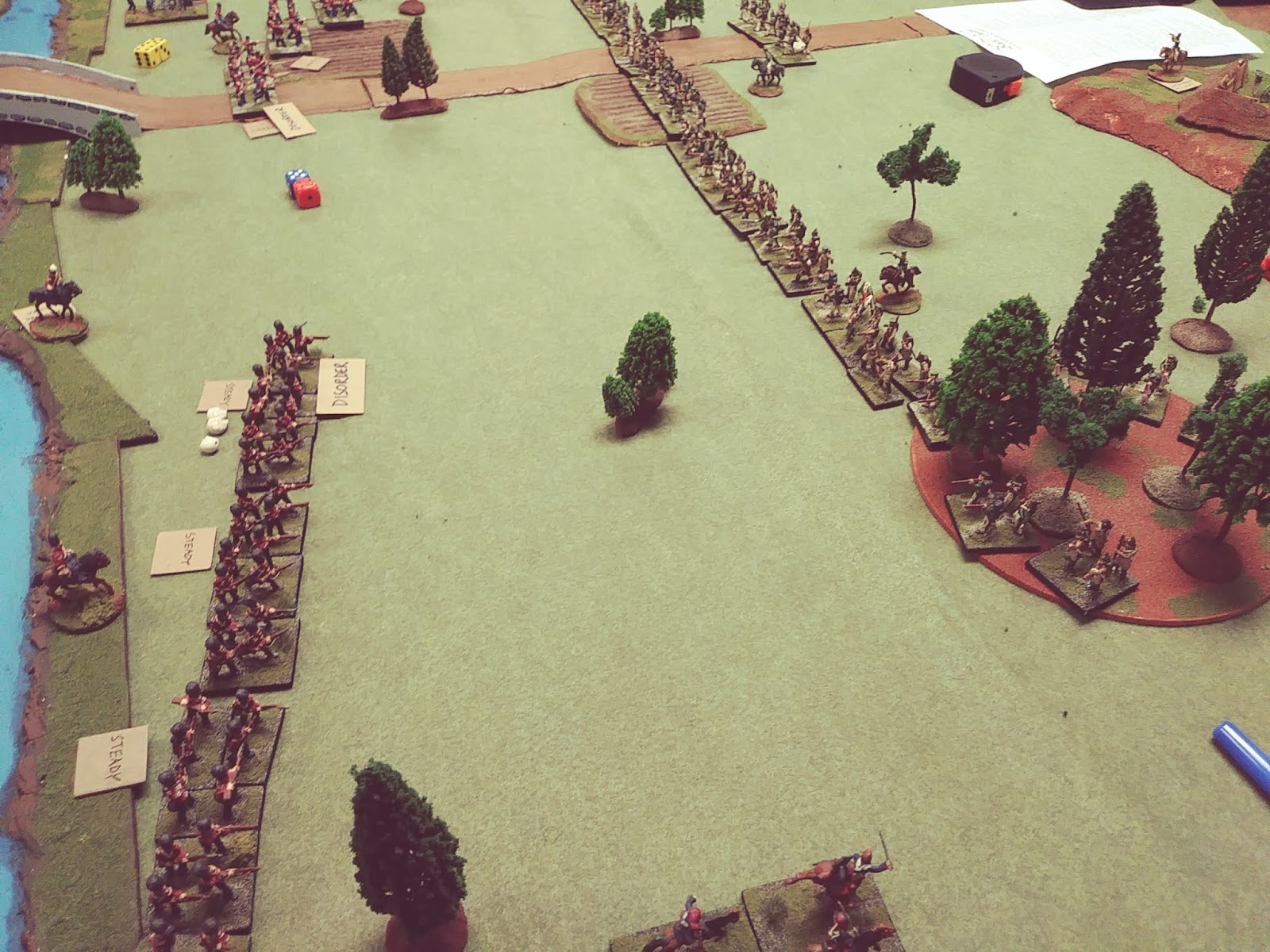
Russians established a very long, dense firing line of infantry in the center
of the table and attempted to out-shoot the British. Most of the British infantry responded by
falling back a bit to be out of Russian range but still in range to counter-fire
with their longer-range rifled-muskets.

(
Above: the long green line of Russian infantry straddles the board)
Meanwhile, a unit each of Heavy Dragoons and
Scots Greys succeeded in getting all the way to the Russian edge of the board,
and turning and charging one of the Russian redoubts, and taking the position –
an automatic partial victory for the British!
At this point the Russian players conceded the
game, since there was no infantry in reserve to protect the other redoubt
position, and losing both would be an automatic full British victory.
I think the scenario was fair in terms of troop
dispositions, and a review of the rulebook the next day confirmed that I did
not adjudicate any rules wrong (phew!).
I'm a little curious why the Russian players chose to stop their advance
midway across the board and engage in a musketry duel, which hurt them because
it whittled down their superior stamina score of 4. With the British heavy cavalry scattered about
on the Russian flank, its seems there was a missed opportunity for the Russian
infantry to put some serious pressure on the British center. Also, a few infantry units protecting the
Russian guns would have been useful in retrospect.
As in the playtests, I ignored the 'brigade
morale' rule (it is optional, after all) and just tracked army morale instead –
so if over half of one side's units were lost (either off table, destroyed, or
on table with 'shaken' status), the entire army was deemed broken and would
commence retreat. I really recommend
this method, with a visual scorecard of some sort to track how close each side
is to breaking, for Black Powder and
probably Pike&Shotte and Hail Caesar! as well.