Showing posts with label H.G. Wells' Little Wars. Show all posts

Monday, May 2, 2022

French Line Infantry

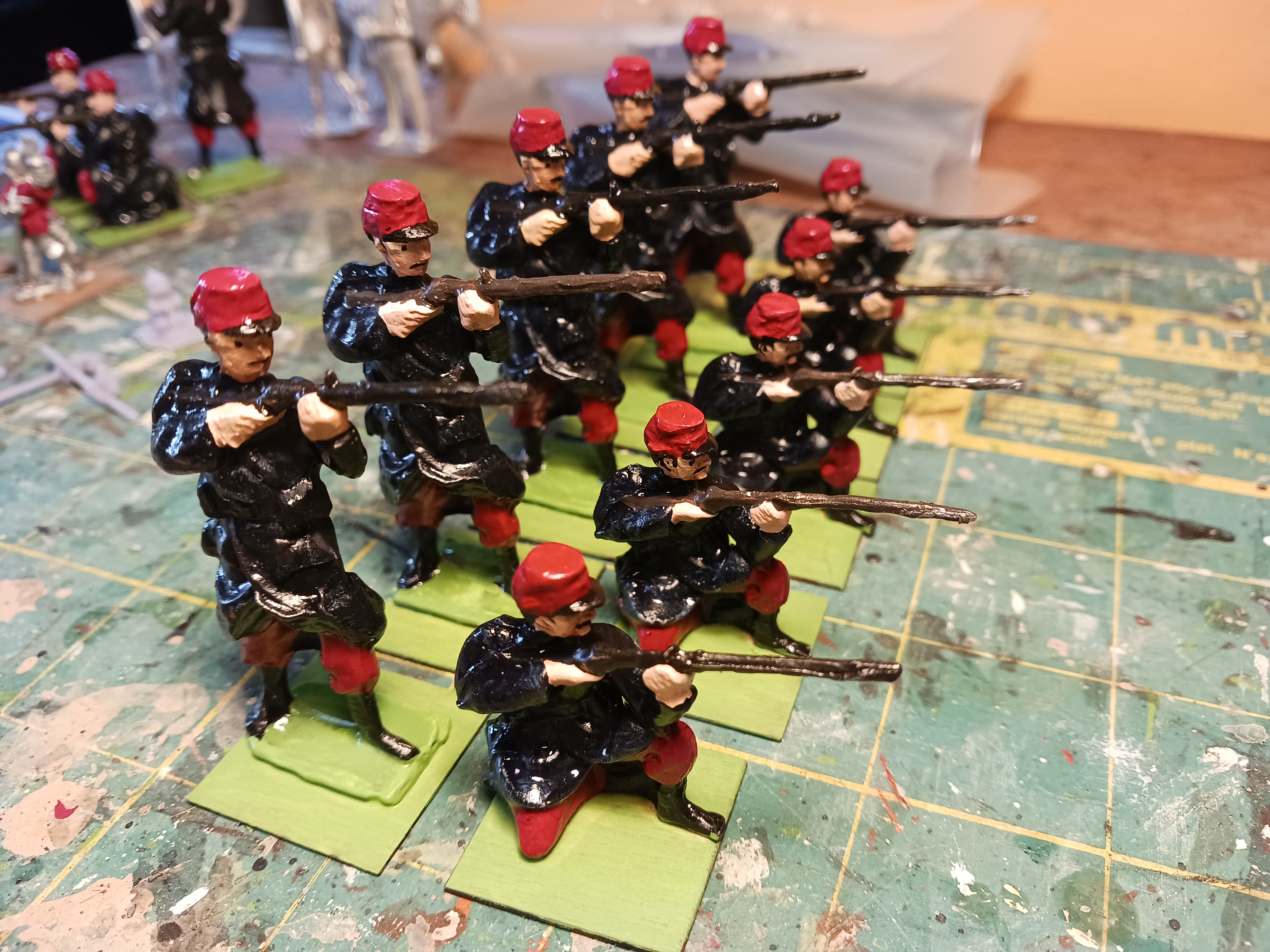
Another thirteen (only ten of which are lined up here) Third Republic French infantry for games in the Little Wars style.  These firing poses will really help break up the uniformity of the marching pose the rest of this army relies on...

The bases are 1mm MDF from Litko.

Wednesday, April 8, 2020

H.G. Wells' Little Wars, the Fight to the Finish

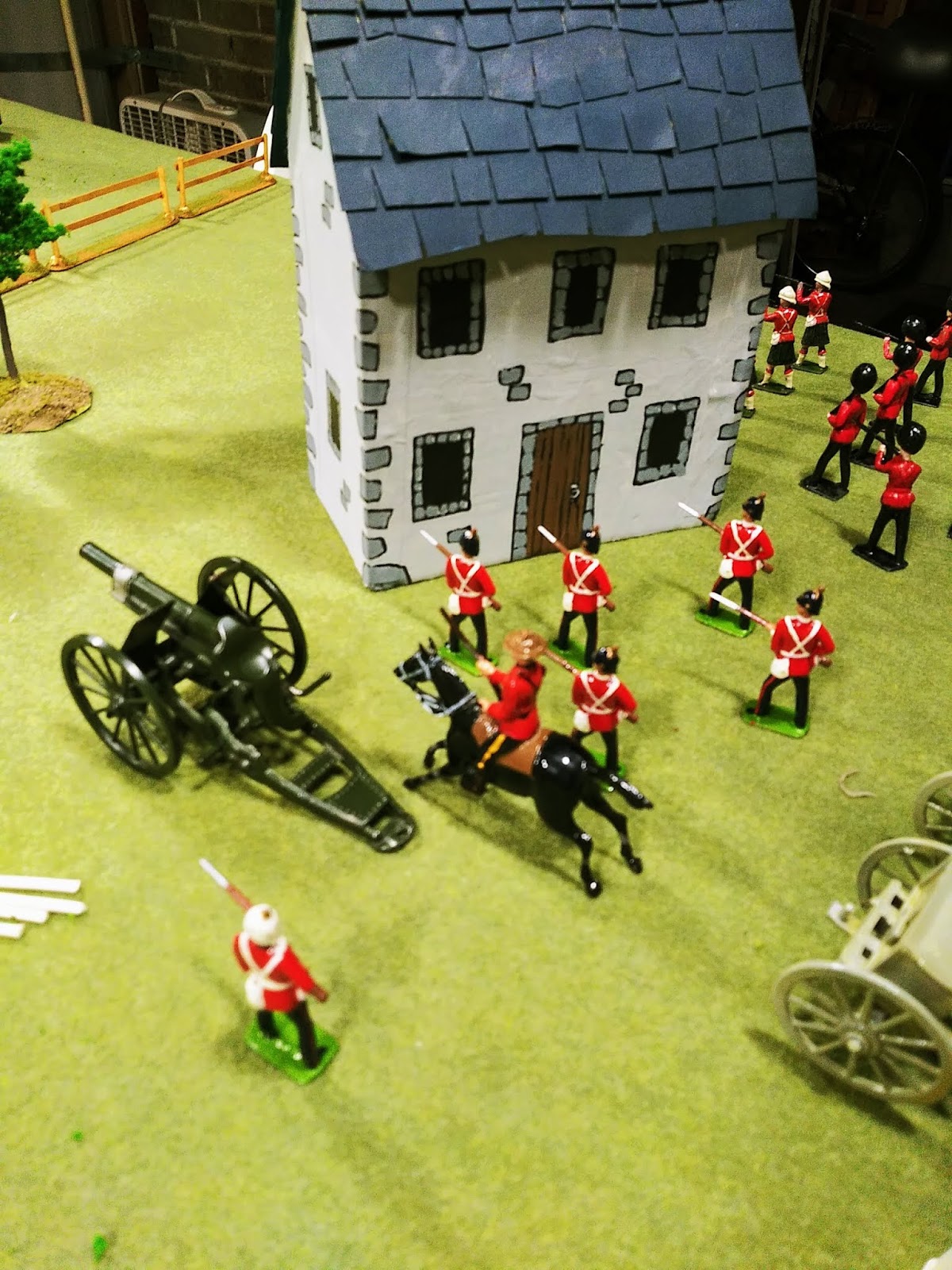
Some additional toy soldiers having arrived, and others having been repaired, a full-throated game of Little Wars was played using the "Fight to the Finish" scenario. The troops were laid out on a side table, the houses and trees and fences were arranged, and a coin flip determined who should set up first. Each side had about 30 infantry, 11 or 12 cavalry, and two guns. "Blue" had two 4.7" naval guns and "Red" had one naval gun and also a Royal Artillery piece.


The overall flow of the game was like this: both sides advanced off their starting lines and then artillery fire exchange began. Blue was able to successfully charge Red's 4.7" and seemed poised to capture it, but on the following turn Red coordinated a counter-attack that drove off Blue forces and re-secured the naval gun. Blue reconsolidated its remaining forces at its center. Red made a very risky charge at the center using a mass of troops which had hitherto been sheltered on its forward right flank - they took a heavy toll from artillery fire and then many prisoners were taken in the counter-attack. Blue then reorganized and advanced on the 4.7 again, at which point Red withdrew from the field. Final score was roughly Blue at 147 points and Red at 38 (Red escaping with both guns and about some troops, and also collecting 7 points from prisoners).


The fences, while nice to look at, tripped up artillery fire too much. Both sides worked hard to minimize open shots against their own troops, and the fences served to only make difficult shots almost impossible. Turns were timed, 3 minutes per side, and you had to move or shoot your guns first. This completely removes the need for chairs at your table as there is no time to sit down. The non-moving player can't sit down either, as it is best for them to stand opposite of their opponent's gun, both to watch for whether a hit was scored or not, and also to try and keep ammunition from getting lost amidst the junk in my basement. When troop counts got below 20 we went to 2 and a half minute turns.


The key to melee is that the determination of whether troops are in melee, and whether each side is supported or isolated, is that the measurement is taken from the point of contact (or contacts).  Therefore, both Red and Blue would have a single man contact another soldier, and then move as many allied troops up within 6" of that contacting man as possible. In this way you can almost guarantee that you will outnumber your opponent in the resulting melee, which in turn tends to lead to prisoner-taking and/or surrendering instead of brutal man-for-man casualty removal.


"But what about small arms fire?" you may ask?  Yes, it is a mechanic that is absent.  But first of all, look at the many photos of this game, and notice that infantry still tends to be positioned as if it were offering rifle fire. In the mind's eye, the exchange of rifle-fire is still going on.  From a mechanic-standpoint, the trade-off here is that by not having small arms fire, you also don't have to have formations or units, and also by extension don't have to deal with facing or coherence and such.


I took a lot of photos - many more than typical! In using the auto-correct function on my camera the order got a little screwy, and I'm not going to caption all or even any of these like I usually do.  The next game will be the "Blow to the Rear" scenario and I've already made two more new buildings which should dress up the table nicely.


Monday, April 6, 2020

H.G. Wells' Little Wars Try-Out Game

After a extensive (manic, even) surveying of online markets, I was able to acquire an "Army Red" and "Army Blue" composed entire of Britains' 54mm toy soldiers (some are older hollow-casts and some are newer solid recasts).  I already had acquired some of the firing 4.7" Naval Guns and had used those in a Black Powder game in 2016 using Armies in Plastic 54mm figures. So rather suddenly, here I was with about 30 infantry, 12 cavalry and two guns to a side, all ready to play H.G. Wells' Little Wars as written!

(Above: I forgot to take pics until the game was basically over. Here's Red closing in for the win.  Note the Blue's Hussars being led away as prisoners at the bottom)

Although we are currently quarantined, I am fortunate to have a ready opponent.  However, for this game I solo-gamed it, to get a feel for the rules.  I was moving stuff around in the basement and prepping a wall for painting between shots of the 4.7s.

(Above: solid-cast Irish guards on the right, old hollowcast guards on the left. Notice how this particular 4.7" gun had to have its trail propped up to get a more level shot)
I use q-tips with the cotton buds cut off for ammunition for the guns. These become warped from hitting the houses fyiand then begin to fly irregularly! I have to admit it's an almost surreal experience to not use dice, although rather welcome and refreshing.  Wells' melee rules is a sort of decision-tree of whether a force is outnumber and if it is, is it is "supported", in which case you may surrender, or fight and have prisoners taken but still incur a few casualties on the enemy.

(Above: Red's Essex Regiment, supported by old hollowcast guards,
move in on rapidly dwindling Blue forces
)

In every ruleset I have read, this is the only one with a surrender mechanic. Why would a player prefer to surrender a melee than tough it out and inflict a few more losses on his opponent? It turns out that if both sides are reduced to 15 figures or less, and the main victory condition has not yet been met, the 100 points for winning the main victory condition is split 50/50 and you tally points as follows: (1) for each of your troops still on the table, 1 point for each infantry, 1.5 for each cavalry, 10 for each gun; (2) for each prisoner you have captured, half a point; and (3) for each figure of yours who is a prisoner of the enemy, half a point. 

(Above: Army Blue gun is manned by the King's Royal Rifles and Queen's Westminsters.
Some Scots Borderers had to fight on the side of Blue to make the forces equal.)

You receive zero points for enemy models killed. It would be possible, maybe, to be very aggressive, "lose" a bunch of melees but have more men taken prisoner than killed outright, and still win the game? Or at least hedge your bets in the event of a 50/50 split - you could win by half a point! Its definitely different than other rule sets.


There was also some testing of my various firing toy cannons to figure out which ones could depress elevation enough to not just shoot over the heads of the enemy all game. Two guns seem problematic, and require something placed under the trail (a spare 3mm thick MDF base worked well) to lower the barrel.

(Above: End-game, basically.  The white-helmeted Red troops in lower-right will attack the Blue gun and result in death of men on both sides. This put both sides at less than 15 men, so it went to points, and Red won.)

(Above: Blue Hussar and Lancer prisoners being led to the rear.)

Next will be a "full" game with timed moves and two guns per side.
Monday, July 18, 2016

"Altogether elegant"

Good fortune has landed me several W. Britains diecast spring-loaded breech-loading toy soldier artillery pieces, including two of the 4.7" naval guns as described in Mr. Wells' Little Wars (or at least the 1960s W. Britains' re-release version of said gun, to be specific).  Mr. Wells called these toys a "priceless gift to boyhood" and noted them "capable of hitting a toy solder nine times out of ten at a distance of nine yards" (!).


I must admit my existing gun crew look quite nicer with the four point seven than with their plastic seven pounder... I shall have to decide on whether to give this play-worn toy a coat of fresh paint or not.

Sadly, the addition of these pieces underlines the notable absence of appropriate cavalry for my British and German armies (1900-1910 period).  This can easily be cured with a purchase, but I cringe at the thought of painting cavalry (for no real reason).

Wednesday, February 12, 2014

Little Churchyard War

Army Dark Blue and Army Red met for a rematch on the dining room table.  We again used a super-simplified house-rules version of HG Wells' Little Wars.


My son had a better time this go-around, as he seemed to do better aiming Army Red's cannon on the table than on the floor.


Highlights included: a dead-on hit on an Army Dark Blue infantryman that sent him flying backwards a good foot and a half; knocking figures off the table edge and having my son say in complete seriousness "I don't think that even hit that guy"; and hiding a guy from ever-closer cannon fire by hooking his base onto the top of a house roof - I countered by hitting the house on my next shot, sending the poor chap tumbling down.


Pretty brutal game of attrition...


I lost, in the end, although I had to coach him a little to take advantage of gains he had already earned all on his own ("I think now would be a good time to use that reserve you've cleverly kept hidden all game.")

Monday, January 13, 2014

Little Wars

I played a(n even more) simplified version of HG Wells' Little Wars with my son (age 6) this weekend.  I played an 18 figure all-infantry Army Red against his combined Army Dark Blue forces of 24 infantry and 8 cavalry.  Each side was equipped with a Playmobil cannon.  Victory would go to the first side to get three figures to the opposite bound of the playing field.  Melee was decided by simply throwing a die each with loser tipping over a figure – in the event of a tie both figs were knocked over.  Terrain was board books stacked upon eachother and some Lincoln log structures. We obeyed Wells' rule of "guns first": that is, you fired your three shots with you cannon at the top of your turn, then did all your movement, then resolved any melee. All movement was 12 inches.


He won rather convincingly but highlights (which placed us firmly in the land of play) included my hitting a cavalry figure, and then having it fall over and knock his companion over, and so forth twice more, like a row of dominos, killing four in one shot! The other trick shot was firing a dart through the doorway of the Lincoln log structure and back out the opposite side to knock over two Army Dark Blue troopers who thought themselves protected.