
Friday, October 13, 2017

Monday, October 2, 2017
Middlewich 1643

We played a game of Pikeman's Lament 'big battle' (no figure removal) using a scenario based on a real event, for a change, and given the pleasing result, I will probably try and make a habit of it more often! The battle was Middlewich of March 13, 1643 during the first English Civil War wherein Parliament's Gen. William Brereton approaches Royalist-held Middlewich from one side while another Parliament force of Trained Bands infantry from nearby Nantwich is en route from the other direction. Middlewich is defended by General Aston's Royalist Horse and some hastily conscripted infantry.
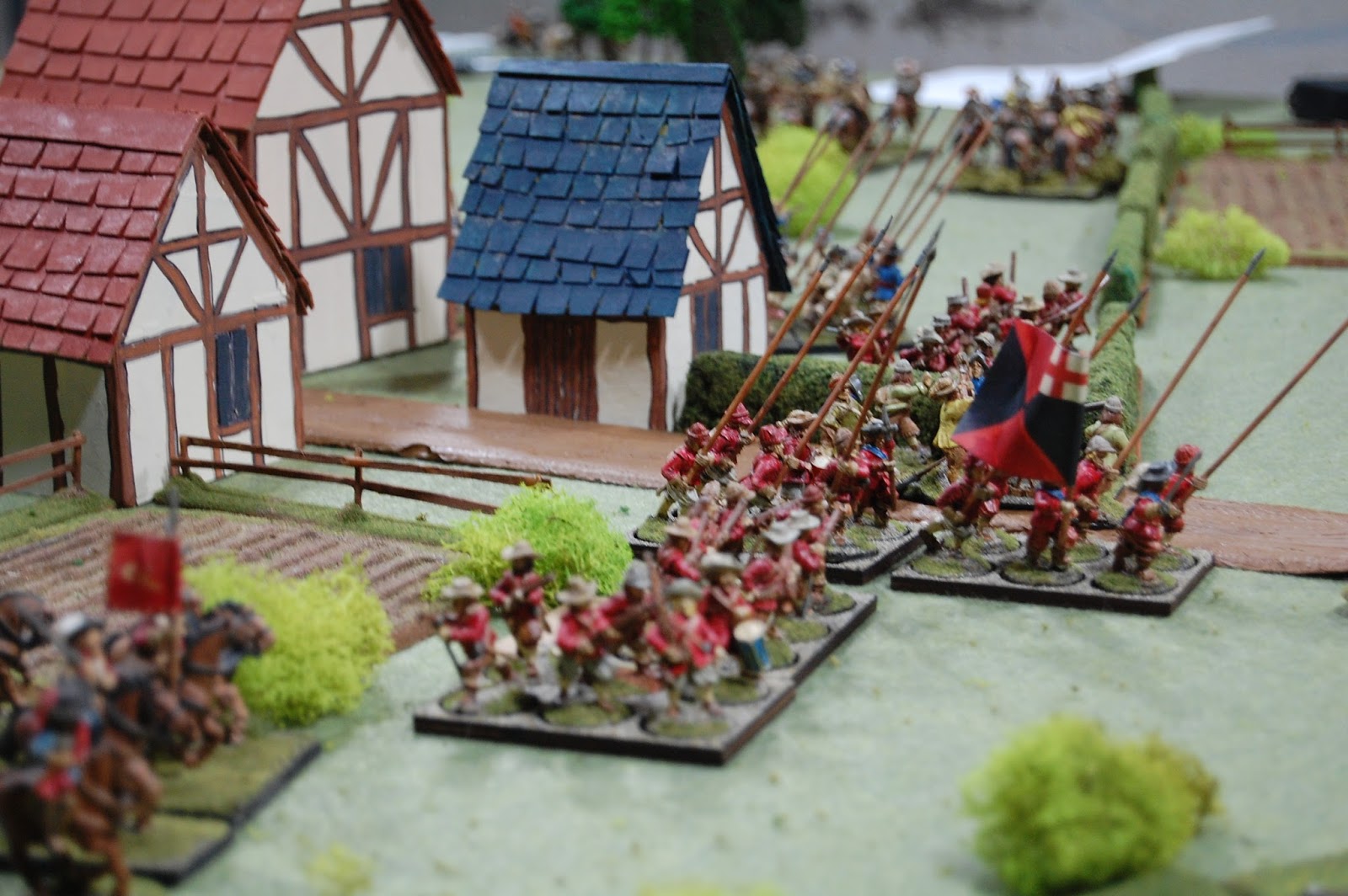
In Pikeman's Lament terms this worked out to a Parliament company on one side (Gen. Brereton) consisting of two elite Trotter units, a regular Trotter unit, a Pike unit and two Shot units, and a second Parliament company (Col. Robert Ellice) coming on the opposite side of the table on Turn 3 consisting of two Pike units, two Shot units, and a Commanded Shot unit. Defending Middlewich is two companies of Royalists (Gen. Thomas Aston): the first being 3 units of Gallopers (with Wild Charge rule) and 2 units of Dragoons, and the second company being a Commanded Shot, three Raw Shot units and three Raw Pike units, plus two falconet guns and crews. This all works out to 48 points per side.

The victory conditions are from the Lion Rampant book's 'Scenario B: Defending the Indefensible' and Parliament must push the Royalists off of a 6"x7" area (the boundaries of which are marked by a piece of cardboard) representing a fortified house in the middle of town (technically this should be a church per history but I do not have one). The Royalists must destroy half of the Parliament forces' points value, for the purposes of which I made a handy tracking sheet that we filled in empty dots as the points were ticked off.

Brereton (Pete) started things off by bypassing the main bridge entirely and sending almost all of his company across an unguarded bridge to the 'south'. Aston (me) mucked things up early by letting valuable cavalry units wander around in the open without much of a plan. When the Nantwich Trained Bands arrived they promptly shot up a unit of Gallopers and both Dragoon units were put to flight by Brereton's Elite Trotters. Brereton even rolled boxcars (double sixes) and received a unit of reinforcements consisting of Parliament Gallopers which thundered across the main bridge, tying of Royalist resources. Aston (me) finally got a clue and turtled up with the remaining cavalry tucked in the town ready to spring forth, which should have been my plan in the first place.


Parliament's grand strategy was to link up both companies to the south of town and make a giant assault to carry the day, and this came together quite nicely, even reducing the defenses of the defended house to just a single falconet, but the Royalists had all pikes form close order and sally forth, retaking the building.


Somewhere around this time Royalist General Aston was either killed or fled the field. The remaining Royalist Galloper finally charged and routed a Nantwich pike unit and then followed-up and routed the Nantwich Commanded Shot as well.


The assault on the key building was stalled and the Royalists were putting a lot of points on the board. Parliament Col. Robert Ellice was either killed or fled the field. Brereton at this time charged the defenses with his Elite Trotters (think Ironsides or Lobsters), rather easily routed the Royalist conscripts therein, and won the day!


This game was played in about 3+ hours, which includes some learning curve for Pete who had not played before. It was also a game designed for four players but we ended up with just two so that may have slowed things a bit (but more toys for us!). I was very pleased with the inefficiency of the Royalist falconets, which only fired a few times, and only once to great effect. Musketry was generally inefficient, and probably more casualties were caused by the 'slow bleed' results of failed Rally rolls (lose one more casualty each time) than firefights. As usual, cavalry essentially determined who carried the field (which seems historically right, to me).

Above: Brereton victorious.
Monday, September 25, 2017
PDX Metro Saga Players
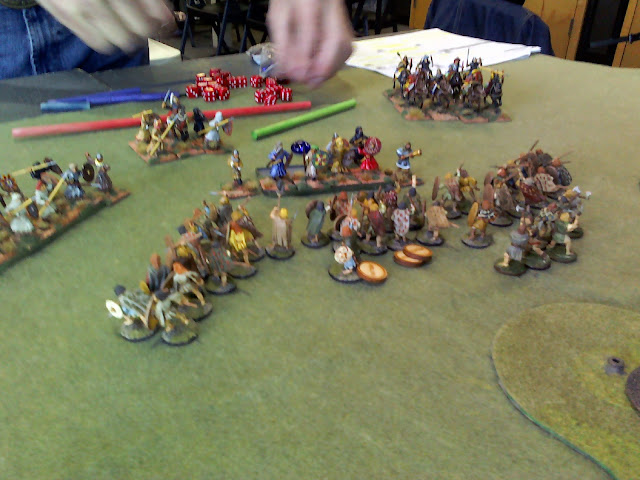
Another fun day playing Saga at Guardian. 8 people and I think 7 games played.




Wednesday, August 16, 2017
Return to Minden-town (Game 2)
The first game having ended in a mere 20
minutes, we quickly reset and played a second game All the Kings Men with most of the same changes as before intact,
but put color-downgrading back in for musketry (but movement was still
free). This arrested the casualty
free-fall effect seen in the first game's few musketry exchanges, although
honestly units were still running across the board too quickly and freely,
which at times ruined that lovely "linear tactics" look of 18th
century games (fortunately the movement bases countered that a bit). Lesson learned is that AtKM's color downgrade
system is fine as it is.
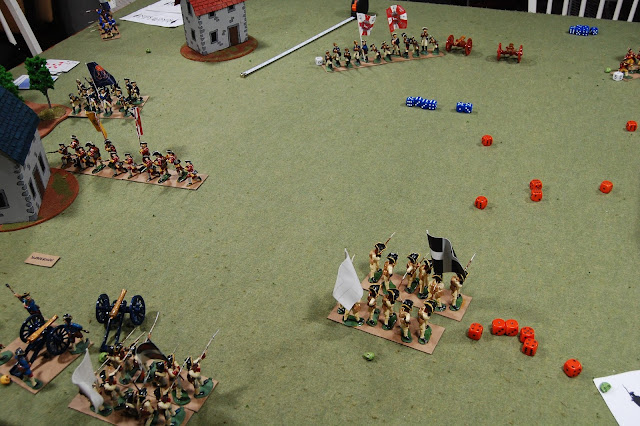
This second game went better for the Allies, although it teetered on edge of disaster. As before the French fearlessly advanced into the face of the Hanoverian artillery and overran the guns, and as before the infantry on the Allied left faired poorly, but on the third reshuffle of the deck, the Allies hit a ridiculous run of cards, and the British, Brunswickers, and Hessians on the Allied right surged forward and broke the Grenadiers de France to steal the win.


Below: the French overrun the Allied guns for the second time.


Above and below: the game-winning push by the Allied right against the Grenadiers de France.


This second game went better for the Allies, although it teetered on edge of disaster. As before the French fearlessly advanced into the face of the Hanoverian artillery and overran the guns, and as before the infantry on the Allied left faired poorly, but on the third reshuffle of the deck, the Allies hit a ridiculous run of cards, and the British, Brunswickers, and Hessians on the Allied right surged forward and broke the Grenadiers de France to steal the win.


Below: the French overrun the Allied guns for the second time.


Above and below: the game-winning push by the Allied right against the Grenadiers de France.


Tuesday, August 15, 2017
Return to Minden-town (Game 1)

I just re-situated my games table to the opposite corner of the basement, where it 'floats' with not one edge pushed up against a wall. This is visually more appealing and also increases the playing-board significantly – when the table was up against a wall, one would unconsciously cede up to 12" of that part of the table because the wall was there. We broke out the long unseen 54mm Seven Years War collection and ended up having two inaugural games (since the first game ended so quickly – see below) with this new set-up.

The games featured only the "BMC" figures (named after sculptor Bill McMaster) since some of my cavalry units (modified HAT Napoleonic dragoons) were damaged, and I never thought they matched up very well stylistically with the BMC artillery and infantry. So there we had it: five battalions or companies or whatever of Allied (mostly Hanoverians with some Hessians, Brunswickers, and British) infantry supported by two guns versus six units of French infantry also supported by two guns. The paint schemes and banners are all drawn from the orders of battle for Minden in 1759. These games were not a re-fight of the actual Minden – but Minden is its inspiration.

We used the All the Kings Men rules, but I made some changes – (1) ditched the deuce and joker card draw effects; (2) turned the King card effect into rally one unit back to green status; (3) ditched all rules for generals; (4) ditched downgrading color for anything other than taking casualties or being in melee; (5) added activation to rally and upgrade by one color level; (6) units are movement bases, so no figure removal; and (7) added simple victory conditions of automatic victory if you could get two units in contact with opposite board edge ("breaking the enemy lines"), which seemed reasonable given lack of cavalry.

Above and below: Hanoverian troops on the Allied left.

Below: fighting in the woods.


Below: the French advance begins.


Above and below: French units victorious in the center.

The lack of color downgrading meant that a good run on the card draws ended up with the French advancing clear across the field in the face of the Hanoverian artillery unscathed and knocking both out without taking a single casualty or any kind of fatigue at all! Artillery in fact was completely useless, since targeted units were always at green (so counter-rolls to cancel hits against artillery fire were always on a 4+, and since they were rolling 12 dice vs. the artillery's 8, it was a bit of a non-contest).
The game lasted about 20 minutes and saw both Allied artillery units plus two infantry units put to flight, which equaled more than half so the entire army withdrew from the field.
Saturday, August 12, 2017


Subscribe to:
Posts (Atom)