Monday, April 9, 2018

Italian Wars Cavalry

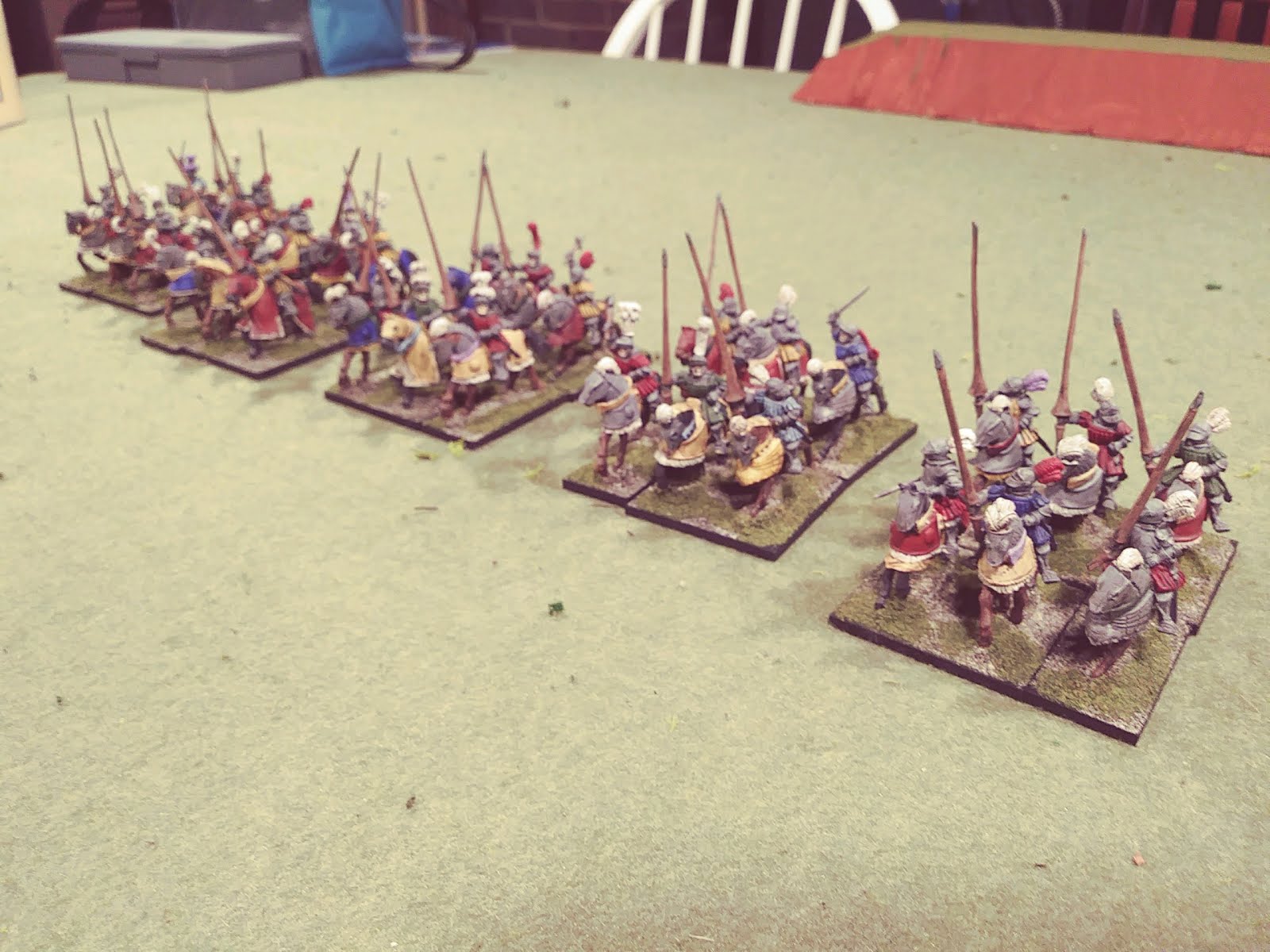
On Saturday I finished flocking my Italian Wars cavalry, which completes the "February and March" sections of my Italian Wars painting schedule (although that schedule does not accurately reflect that I ended up painting 30 Elmeti and 30 Gendarmes and not the 18 of each original envisioned).  These 72 cavalry were completed between February 11 and April 7th, about 8 weeks.  I have painted 228 Italian Wars figures since December 1 of last year, and 288 figures since last June, and have reduced something over 20 full bags of Old Glory miniatures to just 1 (a pack of Spanish genitor cavalry) (not including the next batch I am now starting).  Since part of this project was not only to paint up armies for a game at Enfilade in May, but also to significantly reduce my 'lead mountain', I am obviously very pleased right now!

The Italian Elmeti (Old Glory condottiere) by were super easy as the horses are not armored and the riders are wearing plain plate armor without even plumes for decoration.  The Elmeti armor may be a little old fashioned by the Italian Wars but I want them to be visually distinctive from their opponents.  The French Gendarmes were the big time-consumer this time around, since I was going for a rainbow effect of several combinations of colors on those. All figures are Old Glory except two of the Stradiot light cavalry which are by Perry.  I also started but did not complete three commander figures. In the 'assembly line' painting process for painting these, three individual figures just got skipped over repeatedly - I have added these to the next batch which has quite a few command stands in it as well.

GENDARMES


ELMETI


STRADIOTS


ALL THE CAVALRY SO FAR


Up next:

8 artillery stands with crew.
12 mounted crossbowmen.
6 or 12 light cavalry for the French.
Assorted mounted command stands.
4 baggage wagons.

Thursday, April 5, 2018

War Griffon completed!


Well, not completely done - I still need to sand and flock the base.  And it turns out I (repeatedly) forgot to paint the little chinstrap on the rider's helmet.  But this is otherwise varnished and everything.


I got this figure maybe 2-3 years ago. The rider's sword arm (a separate piece) was missing, and repeated attempts to source a cheap donor model to part out for a spare gauntlet-with-weapon were not successful. More recently I've been hankering to play Dragon Rampant again, but with larger armies ("big battle" style such as we have been doing with Pikeman's Lament and Lion Rampant) and using some of the scenarios from our historical games (such as our Middlewich game).

I'm not really a big fan of the Empire and Bretonnia lines by GW, with the exception of a few select items (this griffon rider, GW's older flagellants, some of the older Empire Knights), but I do like Black Tree Design's "Helsinians" line (formerly made by Harlequin) - mainly because they have a look to them that is not Empire/Bretonnian (although their 'Averaign' line, by contrast, looks very Bretonnian).  I have enough figs from the Helsinian line to make three units of foot, plus a unit of flagellants/fanatics, and also the old GW Empire War Altar model, so that should make a good core army.

Monday, March 26, 2018

Marston Moor (or less)

On Saturday, Saint Patrick's Day, we got together to play a mega game of Pikeman's Lament. The scenario was Marston Moor, with all of my and Gabe's ECW collections (which is over 325 figures and about 44 units on the table). The Parliamentarian and Scottish Covenanter allies had a few more units but included a few Raw units, while the Royalist forces were slightly outnumbered butt had more Elite units.

The Allies were deployed on a ridge or immediate at the base of it, representing the slightly higher ground they had in the historical battle. The Royalists were deployed behind a hedge, representing the ditch present at the historical scene.  The goal of my setting up this game was not just to have a mega game, putting all available figures on a table, and to eat pickled eggs and drink beer with good company, but also to test the limits of the Pikeman's Lament ruleset, a game whose stated purpose to be a skirmish ruleset with perhaps 4 to 6 units per side. As written elsewhere, I am planning to run and Italian Wars scenario at Enfilade in May for up to six players, and since I am still painting all the necessary units, I figured I could experiment now using ECW collections.

All I'll really say about the game is that while he Allies carried the day, while the Royalist left did succeed in routing the Allied right, during which Prince Rupert and Oliver Cromwell engaged in personal combat (Rupert won)!  But the Royalist offense ran out of horses and men, and their center and right were fairly depleted while the rest of the Allied line had not sustained many losses at all.

Game play was a fast three hours, and with six players instead of five it probably would have gone even faster, we think.  For my Italian Wars game (or any other Pikeman's Lament convention game), I would drop all officer special attributes as players kept forgetting to use them, and I would drop the "special things happen on a snake-eyes or box-cars roll of the dice", but otherwise I think the rules can be run as is and learned quite quickly by the players on the spot (we had two players who were familiar with, but had never played the other Rampant titles).

Anyway, on to the good part: the photos of over 300 figures!

Unless otherwise noted, pics are by me.


(Above: photo by Pete - this I the one unit he brought for use in the game)


 (Above: photo by Gabe)


 (Above: photo by Gabe)


 (Above: photo by Pete)


 (Above: photo by Gabe)


 (Above: photo by Gabe)


 (Above: photo by Gabe)


 (Above: photo by Gabe)


(Above: photo by Pete)


 (Above: photo by Pete)


 (Above: photo by Gabe)


 (Above: photo by Gabe)


 (Above: photo by Gabe)

Tuesday, March 20, 2018

War Griffon

I managed to block paint and dry-brush this over the course of the weekend - a nice distraction from the never-ending Italian Wars painting slog!


Quite pleased with the feathers although the picture isn't quite perfect.


I'll probably use a dark-brown-only wash on this fella (my new preferred wash is a dark-brown/black mix which gives a nice ink effect).

The human rider is done too.

Wednesday, February 28, 2018

Gendarme painting guide

Working on painting 72 cavalry for my Italian Wars project, and having to get down to the nitty-gritty of how to decorate all the French gendarmes (the Italian Elmeti are easy by comparison - head to toe in plate armor, horses are not armored at all).  As before with the infantry, I'm trying to use contemporary art as inspiration. And again as before, paintings of the Battle of Pavia (1525) are numerous and easily found so let's see what we've got!

A quick note: there's three things I'm looking for: (a) the colors of the tunic things the Gendarmes wear over/under/around their armor; (b) the color of the feathers/plumes on their helmets, and (c) colors and decorations on their horse armor.

In the below detail, the tunics are mostly rich yellow (saffron?) with some red ones as well.  Helmet plumes are overwhelmingly white with some blue and yellow.  Horse armor is not painted, painted flat red, or is blue or yellow with a lot of decorative detailing.  Lances are all of plain wood.


In the next one below, tunics are again red or yellow.  Plumes are red or white.  Horse armor is is red, an ornate, decorative yellow/gold/brass, or a blue caparison with fleur-de-lis on it.


In this detail below, we see white plumes again, and a blue or green tunic with yellow trim (on the right) in addition to the usual red tunics. Horse armor is yellow/gold with a lot of detailing.


This next detail is from the bottom of the subject painting so you can't see the horse armor very well, but the fellow to the bottom right's horse has white armor with blue detailing. Otherwise red and yellow tunics are uniform with white and red plumes. Lances are all of plain wood.


Next up is the full-size painting identified by the web as the Battle of Issus (a battle of Alexander the great), but it clearly shows Imperialist heavy cavalry and infantry chasing off stradiot light cavalry and other pikemen.  If you look in the middle where infantry are clashing you can see some doppelsoldners using their two-handed swords.


In the below detail from the 'Issus' painting is a ton of heavy cavalry.  These are likely not French gendarmes but still the same patterns are present: white helmet plums and red tunics. Horse armor is mostly not colored but there some red and  a very dark blue. Lances are all of plain wood.


The below detail is from the cavalry scrum in upper middle of the 'Issus' painting. Red and yellow tunics again. Unpainted horse armor.


So, I've got 30 gendarmes that will make up five units of six figures each.  I'm thinking the riders will mostly have yellow or red tunics, but a minority (maybe even only one figure out of each unit) will have 'royal blue' tunics.  For plumes maybe 20 will be white, 10 red, and the rest a mix of white with yellow or blue.

Horse armor is the trickiest. Perhaps 6 with just metal armor with no paint. There are few which have cloth caparisons so those will be red or yellow with patterns or decoration.  Then I'm thinking I'll pull six and do those in blue or white, all with decorations.  That should leave 12-15 remaining and those will be just red or yellow with no decoration.

[EDIT - WANTED TO ADD A FEW MORE PAINTING I FORGOT ABOUT]

Below is a painting of Louis XII (king of France from 1498 to 1515, so most of the Italian Wars) riding out to do whatever with his Gendarmes.  Being a king, his horse armor is of course very decorated. But his bodyguard mostly conform to the prior paintings: red or yellow horse armor, red or yellow tunics, white plumes with some variation (purple!).


Below is another painting of Louis XII, this time parading through the streets of Genoa.  As you can see he is wearing a quite different set of colors. If you look carefully, I'd wager a guess that one of these paintings is a copy of the other (albeit inversed).


Neither of these paintings of Louis XII are going to change the color scheme for my Gendarmes, but I wanted to share that perhaps kings, nobles, and royal guards and the such might have used more elaborate tunics and horse armor.
Monday, February 12, 2018

Italian Wars infantry #2

10 days past deadline, but the 'infantry phase' of my Italian Wars painting schedule is finished! I painted and based over 156 infantry between December 1 and February 10!  Add to this the 60 I painted last June and I've got 216 rank-and-file figures for my Fornovo 1495 game at Enfilade!  I flocked the last of the bases yesterday morning and set them all out for parade on the table late afternoon.  This is all 216 plus the four commands I have so far.


(Above: these are the 'Swiss' or 'Italian' figures by Old Glory, plus a few Perry figs mixed in. I did not paint them in a 'Swiss' style, i.e. the white-and-red livery of Berne because I didn't want them to be exclusively Swiss. I have some unpainted Perry plastics and metals that I might do in the Berne livery later)


(Above: the landsknechts.  I am doubtful that the infamous doppelsoldners actually fought as separate units, but they're different-looking and fun to have on the table so there you go!)


(Above: I'll admit I had my moments of doubt with my color palette selection, but I am satisfied with the end result.  These are all Old Glory except the command and some of the arquebusiers)


(Above: Landsknechts.  I'm doubtful that there were very many full-on landsknechts, slashed sleeves and all, at Fornovo in 1495 (nor were there that many arquebusiers), but for this scenario they'll be there in force)

            
(That's a Perry Italian commander. Mounted command for the Italian Wars are hard to come by)


Next up is 60 heavy cavalry (which will break out into 12 units of 6 figs each) and 12 stradiot cavalry, plus some more commanders.

Monday, January 8, 2018

Somewhere in Italy, c.1040s

On Sunday we tried out a sort of 'big battle' or 'convention' variant of Lion Rampant.  Something Gabe and I have been chatting a lot about lately is trying to escape the 'Anglo-centric' orbit of a lot of wargaming – in this case it meant playing a dark ages type of game set in continental Europe and not in the British Isles.  This was pretty easy to do, since Gabe has managed to end up with a rather large collection Normans and Bretons, and the particular look of these models (nasal-helms, kite shields) is essentially universal to the European continent in the 10th and 11th centuries. 

The purpose of this "try-out" game was for Gabe to get a good inventory of all his continental figures, as well as to try out some add-ons to the Lion Rampant rules which we felt would add more continental flavor, as well represent "big battles".  For my part, I am interested in (eventually) getting into some 13th century feudal armies (Frederick II, the Guelphs and Ghibellines and all that), and this game presented opportunity to get a feel for that kind of game.
 
After an inventory of all the available figures, the initial set-up involves 38 points per side, consisting of the following: 
  • 2 units of mounted men at arms, each with Drilled upgrade ('Milites')
  • 3 units of mounted sergeants
  • 1 unit foot sergeants
  • 1 unit crossbowmen
  • 1 unit archers
I contributed/substituted some dark ages Scots cavalry and some time-traveling Hussite crossbowmen to bring some units up to strength.
 
I deployed my army (which I declared to be that of the Count of Naples) in a historical manner, with a first line of all the infantry, a second line of the mounted sergeants, and a third line of my Milites. 


Gabe (playing the Norman Hautevilles) deployed his infantry to one flank his milites and sergeants to the other.


Our rule-modifications were as follows (mainly porting over select rules from Pikeman's Lament): 
  • No figure removal.
  • Zone of control for friendly units reduced from 3" to 1" (as in Pikeman's Lament)
  • Each side had two leaders instead of one. 
  • Leaders confer a +1 to activation roles to units under their command within 12" of their unit, in addition to their regular +1 to courage checks (as in Pikeman's Lament)
  • Lion Rampant limits on number of types of units you can have are disregarded.
Scenario was loser would be first side to lose half its points worth of units.  38 points per side so magic number for both sides was 16.  The rub here was that the Milites, which are mounted men at arms with the Drilled rule (so no wild charge), are the most powerful units on the table, but also the most expensive (7 points vs. 4 of everything else) – losing even one Milites would bring your army almost half way to the breaking point!


(Above: look at those neat three lines advancing!)

With the +1 to activation rolls conferred by the leaders, both sides easily maneuvered forward.  I brought all three of my lines up neat and orderly.  Gabe incurred a few casualties on the first line with shooting and then attacked my crossbowmen with some Hautevilles mounted sergeants.  The crossbowmen lost the combat (3 casualties), but when they retreated back the sergeants in the second line were too close, and the crossbow lost 3 more as a result of not being to fall back in good order.  Then the foot sergeants in the center of the first line took some shooting damage (as a recall) and totally boffed the resulting courage check.  They fled the field (this a common occurrence for me!), and since the leader of the foot was in said unit, courage checks were incurred up and down the first line, and the Crossbows, being at -6 on such a check, also fled. The archers fell back in a Battered status.


(Above: hey, where'd that first line of infantry go?)

So just like that the entire first line completely cratered on me.  I tried to make lemonade from lemons and made it a bit interesting (mainly my Milites were able to get in and bloody up a few Hautevilles) but the archer unit repeatedly failed rally tests eventually it fled as well, which put me at 12 out of 16 points lost.  My final gambit was to have my leader's Milites attack the Hautevilles' leader's Milites and hope for a miracle. I did not get one.
 

(Above: End-game.)

Overall this was an entertaining and engaging game. The tactical decisions were interesting and fun, given that both sides were so cavalry-heavy, one had to constantly consider the long "reach" of those mounted units, which could easily cut horizontally across the field 10" and shift the emphasis of the game.  Some more foot sergeants would definitely enhance future games, to create a sort of anchor for each side.  As noted elsewhere, the use of a small dry-erase scoreboard, to keep track of how close exactly each side was to its breaking point, really clarifies and focuses the game (you can use the same thing for Hail Caesar, Black Powder etc.), and I highly recommend trying one out the next time you play Pikeman's Lament or Lion Rampant.